
Debris and tree damage repair: roof, siding, and structural restoration
If a tree has fallen on your home or storm debris has damaged your roof in Denver, here is what to do first. We respond fast with same-day tarping and board-up to stop water intrusion, then full roof and exterior repair, with the insurance claim handled start to finish.
Request a free inspection
Tell us what happened. For active intrusion we dispatch same-day tarping or board-up, then send a written report with photos within 24 hours.
Assessment, stabilization, and full restoration
Direct answer: When a tree or storm debris hits your home, Precision Exteriors Restoration responds fast across Denver and the Front Range, with same-day tarping and board-up to stop water intrusion, then full roof and exterior repair. A licensed Colorado contractor (License #0248041) since 2016, we document the damage with photos and manage the insurance claim from start to finish. Call (720) 408-1840 for fast response.
Debris and tree damage cleanup by area: Denver and Thornton.
Debris and tree damage is one of several storm perils we restore. This page covers the impact category specifically, when a physical object strikes the home. For wind-lifted shingles and pressure damage see wind damage, for bruising and granule loss see hail damage, and to start at the top of the tree see our Denver storm damage hub.
Not all debris damage is the same
Direct answer: The cause, mass, and velocity of the impacting object determines the type and severity of debris damage, and what the appropriate response looks like. The four patterns we see most across Denver are fallen branch impact, a fully uprooted or fallen tree, wind-driven debris, and progressive damage from overhanging limbs.
Fallen branch impact
The most common tree-related damage. A large branch carries significant kinetic energy and can penetrate roofing, crack siding, shatter windows, and crush gutters.
Uprooted or fallen tree
The most severe category. Tree on the roof can collapse roof sections, break rafters or trusses, and penetrate into the attic space.
Wind-driven debris
Branches, fence panels, gravel, and objects from neighboring properties strike any exposed surface at significant velocity, scattered and multi-system.
Overhanging limbs
Progressive abrasion, scraping granules and scratching coatings, plus retained moisture that drives rot and algae at the roof deck below.
Fallen branch impact
Fallen branches are the most common form of tree-related damage to residential exteriors. A large branch falling from height carries significant kinetic energy and can penetrate roofing materials, crack siding panels, shatter windows, and crush gutter sections. Branch impact damage ranges from relatively minor, a small limb that scatters granules and leaves a surface dent, to severe structural damage where a large branch has punched through the roof deck, broken rafters, or collapsed a section of the roof structure. The weight of the branch, the height from which it fell, and the angle of impact all affect how far into the structure the damage extends.
The most important characteristic of branch impact: the visible damage at the surface often understates the structural damage below. A branch that has been removed may leave a relatively clean-looking opening in the shingles, while the underlying roof deck, rafters, and ceiling structure have sustained damage extending several feet beyond the impact point. Shingle damage from a fallen branch is almost never the full story.
Uprooted or fallen trees: tree on roof
A fully uprooted or broken tree falling against a home represents the most severe category of debris damage. The mass and momentum of a large tree produces impact forces that can collapse roof sections, break load-bearing rafters or trusses, penetrate through multiple layers of the roof assembly into the attic space, damage or collapse exterior walls at the point of impact, shatter multiple windows simultaneously, and destroy gutter systems along the entire impact zone.
Roof damage from a fallen tree is categorically different from other storm damage because the structural loading extends far beyond the direct impact point. A tree that comes to rest across a roof ridge continues to exert downward load on every structural member beneath it, even members that were not directly struck. This ongoing load causes progressive deflection and failure in framing that may have appeared undamaged immediately after the event. Tree falls often occur during saturated soil conditions, when prolonged rain weakens the root-to-soil bond, or during high wind events that exceed the structural capacity of the tree. Because they frequently happen during active weather, the structure is often exposed to ongoing rain intrusion immediately after impact. Emergency stabilization is typically the immediate priority after a tree on the roof before permanent restoration can be assessed and planned. Learn more about emergency storm response.
Wind-driven debris
Wind-driven debris encompasses a wide range of objects, branches, fence panels, outdoor furniture, gravel, construction materials, signage, and objects from neighboring properties, that become airborne during high wind events and strike the home at significant velocity. Unlike falling debris which impacts primarily horizontal roof surfaces, wind-driven debris can strike any exposed surface at nearly any angle. Siding panels, windows, doors, soffit, fascia, gutters, and even foundation-level components can all be impacted in the same event.
The damage pattern from wind-driven debris is typically scattered and multi-system. A single storm may produce storm debris roof damage on one slope, a cracked siding panel on one face, a broken window on another, and damaged gutter sections at two corners. A full exterior inspection is necessary to identify all impact points rather than just the most visible ones. When the same storm carried high winds, pair this assessment with our wind damage evaluation.
Overhanging limbs and progressive damage
Not all tree-related damage is sudden. Overhanging limbs that contact the roof surface during wind cause progressive abrasion damage, scraping granules from shingles, scratching through surface coatings, and creating moisture pathways that do not involve any single dramatic impact event. Limbs that rest on or repeatedly brush against the roof also retain moisture, creating conditions for accelerated shingle degradation, algae and moss growth, and wood rot at the roof deck directly beneath the contact area.
This progressive damage mechanism is distinct from storm-related sudden impact, and is treated differently by insurance. Damage from overhanging limbs is typically considered a maintenance issue rather than a covered storm event. However, a storm that causes a previously overhanging limb to fall and penetrate the roof creates a sudden and accidental event, a covered peril, even if the limb's proximity to the roof was a pre-existing condition.
One impact, multiple systems at risk
Direct answer: Debris and tree damage rarely stops at the surface it strikes. A single branch or tree can compromise the roof assembly, the siding and wall sheathing behind it, windows and door frames, and the gutter system, which is why a full multi-trade exterior inspection matters more here than with any other storm peril.
🏠 Roof and structural damage
Even a moderate branch can puncture shingles and underlayment, opening a direct path for water. Impact can crack roof deck panels, and severe events break rafters and trusses, the structural damage most frequently underestimated in initial visual assessments. Flashing near skylights, chimneys, or pipe penetrations can be displaced even when surrounding shingles look intact.
See full storm damage restoration ›🧱 Siding damage
Direct impact cracks, fractures, or punches through vinyl and fiber cement panels, letting moisture into the wall assembly where it drives mold, rot, and insulation degradation. Heavy impact can push panels off their mounting channels, and in significant events the wall sheathing and house wrap beneath are torn and must be repaired before new siding goes on.
See siding repair and replacement ›🪓 Window and door damage
Broken glass is one of the most common consequences of high-wind debris events, creating safety hazards, weather exposure, and a security concern that usually needs emergency boarding first. Heavy impact bends and distorts aluminum and vinyl frames, and significant impact at openings damages the rough framing and sill well beyond the window unit itself.
See window repair and replacement ›💧 Gutter and downspout damage
Direct branch or tree impact crushes and deforms the aluminum channel, blocking drainage and pulling the gutter away from the fascia. Severely deformed sections require full replacement, a crushed run cannot be straightened to restore performance. The fascia board behind the gutter is frequently damaged in the same impact and must be addressed to remount the system properly.
See gutter repair and replacement ›Denver conditions that bring trees down
Direct answer: Tree falls cluster around saturated soil and high wind. Denver and the Front Range see frequent downslope and bow-echo wind events, heavy wet spring snow that loads brittle limbs, and mature street trees in neighborhoods like Park Hill, Washington Park, Congress Park, and the Highlands, where large canopy sits directly over rooflines.
March and April wet snowstorms add hundreds of pounds to limbs that leafed out early, snapping branches onto roofs across the metro.
Prolonged rain weakens the root-to-soil bond, so high wind during or after a storm uproots otherwise healthy trees onto homes.
Established Denver neighborhoods carry tall, old trees set close to the house, putting large limbs directly above the roof and gutters.
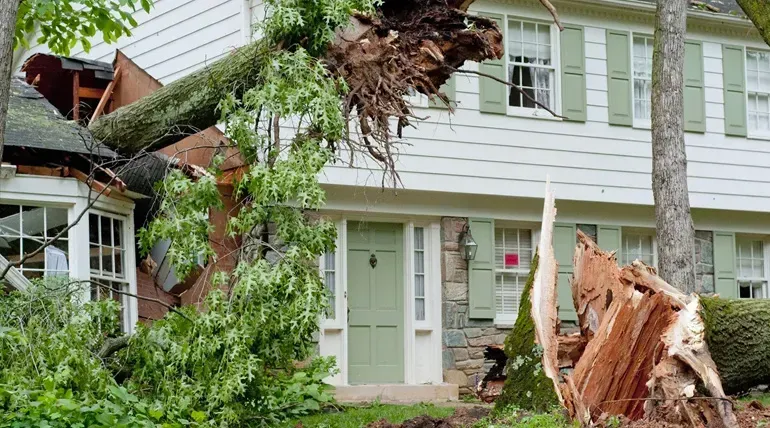 Tree and debris damage, Denver metro
Is tree and debris damage covered?
Direct answer: Sudden and accidental debris impact is generally a covered peril under a homeowner policy. A storm that causes a previously overhanging limb to fall and penetrate the roof is a covered, sudden event even if the limb's proximity was a pre-existing condition. Long-term abrasion from limbs that simply rest on the roof is usually treated as a maintenance issue, not a covered claim.
Because debris damage is multi-system and often understated at the surface, documentation is what protects your claim. We photograph every impact point across the roof, siding, windows, and gutters, capture the structural damage below the visible opening, and build a scope that reflects the full restoration rather than just the obvious entry wound. We then meet your adjuster on site so the deck repair, framing, sheathing, and trim that hide beneath a clean-looking shingle opening are all accounted for. For coverage rules, deductibles, and the claim timeline across every peril, see our Denver storm damage and insurance guidance.
Start my documented inspection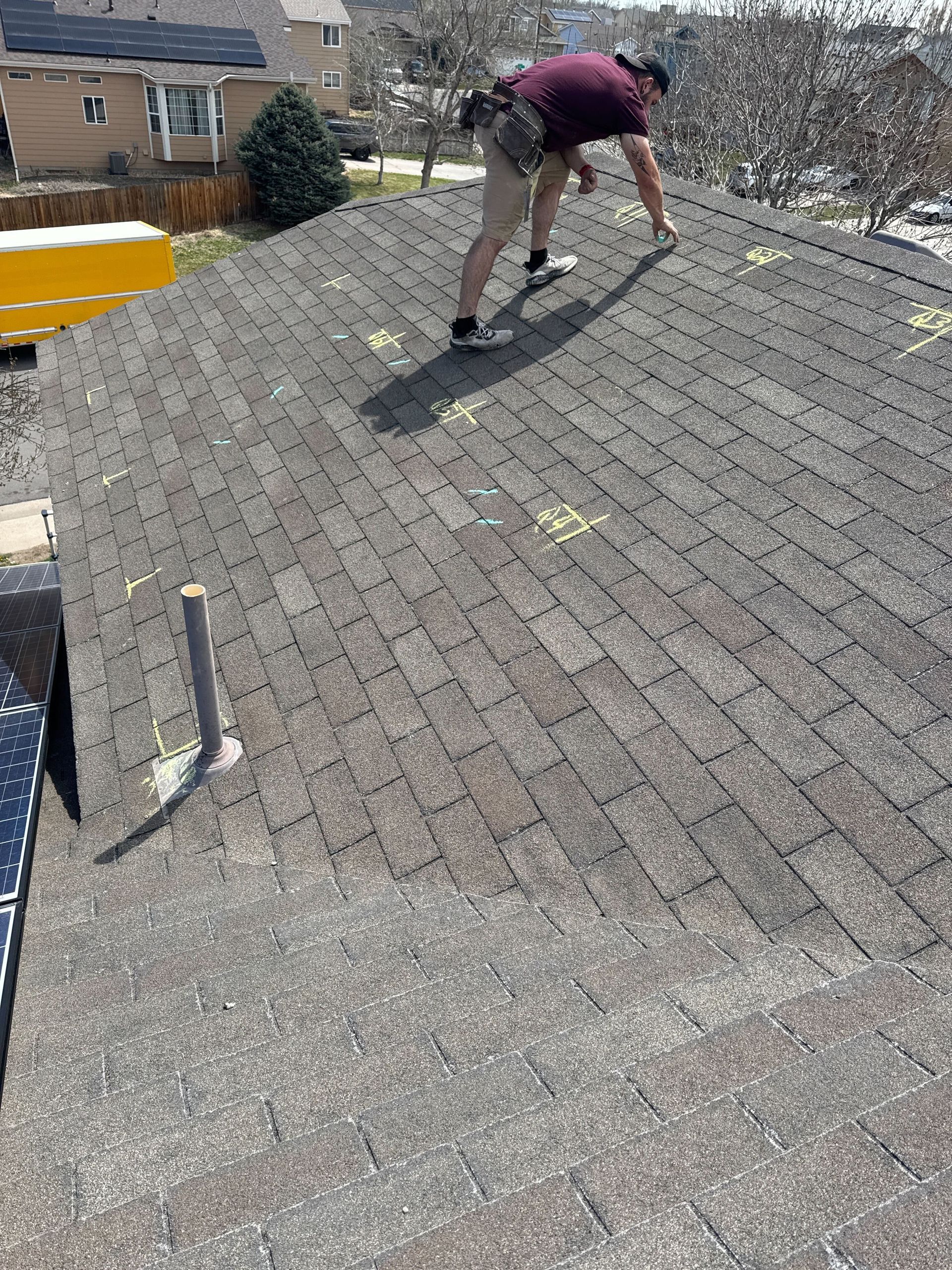 Documented inspection, Denver metro
What drives debris damage in Denver
Tree and debris damage rides the same volatile Front Range weather that makes Denver one of the most storm-active metros in the country.
Your step-by-step debris damage response
Direct answer: After a tree or debris hits your home, the order is simple: get people to safety, call for emergency stabilization, document everything, then restore. We tarp or board up the same day to stop intrusion, complete a full multi-trade inspection, build the insurance scope, and rebuild every affected system.
Safety first, stay clear of the structure
Same-day tarp and board-up
Full multi-trade inspection
Documented insurance scope
Structural and exterior restoration
What your free debris damage inspection includes
No cost, no pressure. Here is exactly what you receive.
- ✓ Full exterior evaluation of every impact point, not just the visible one
- ✓ Roof deck and framing assessment below the surface opening
- ✓ Siding, window, and gutter damage mapped across all faces
- ✓ Written report with damage photos within 24 hours
- ✓ Insurance scope built for the full multi-system restoration
- ✓ Same-day emergency tarping or board-up when intrusion is active
We take the risk off your shoulders
A tree on the roof is stressful enough. Between fast stabilization, manufacturer warranties, and hands-on insurance help, the path back to a sound home is low risk from the first call.
Workmanship and material warranties
As an Owens Corning Preferred Contractor and CertainTeed Shingle Master Installer, we register manufacturer-backed warranties on the roof and exterior systems we rebuild after debris damage.
We handle your insurance claim
We document every impact point, build the full scope, and meet your adjuster on site so the structural damage hidden below the surface is covered, not missed.
Fast emergency stabilization
Same-day tarping and board-up stop water intrusion and secure the home so progressive damage does not spread while the claim is processed.
Rated 4.6 stars by Denver neighbors
Real, verified Google reviews from Denver-area homeowners. We are proud of an honest 4.6 stars rating built one restoration at a time. Read our reviews.
"The Precision team was great and provided me with great customer service and results. Special thanks to Anthony for helping me through the insurance process in making sure the details were covered."
"Great quality work, friendly service. Fast and clean service."
"They showed up on time, they knew their stuff, they did the work, and they did it well."
"Could not give Precision Exteriors a higher recommendation. Professional, timely, and great to work with."
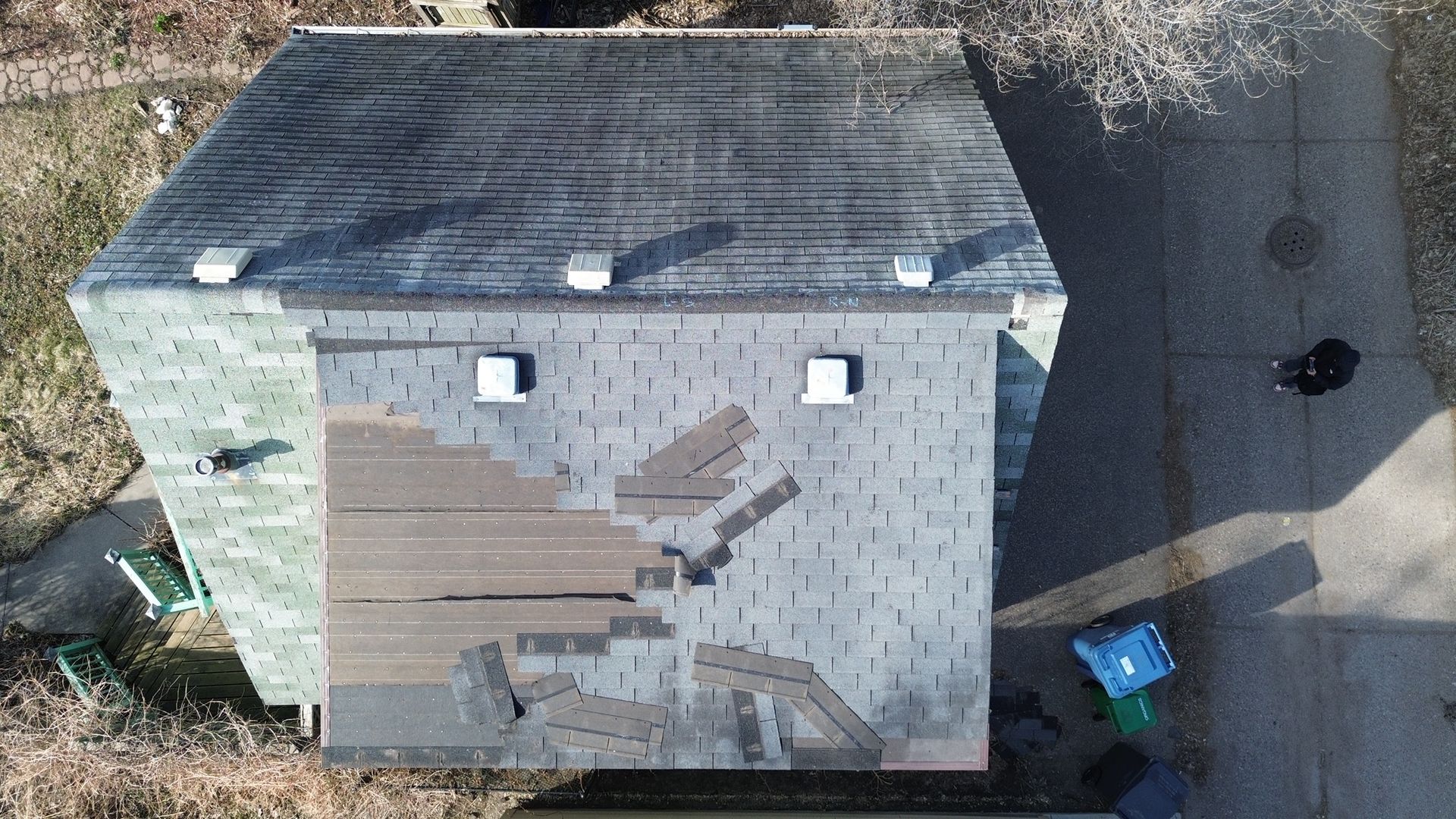 Storm response, Denver metro
Denver metro debris and tree damage service area
Direct answer: Precision Exteriors Restoration responds to tree and debris damage across Denver and the surrounding Front Range, including Aurora, Arvada, Thornton, Westminster, Lakewood, Centennial, and Castle Rock, with fast local crews based at our downtown Denver office.
The Precision Warranty
Protected in writing, for the long run
Every Precision Exteriors Restoration project is backed in writing, so your Denver roof and exterior stay protected long after the debris is cleared and our crew leaves.
10-Year Workmanship Warranty
The Precision Warranty covers the quality of our installation for a full decade, in writing.
Certified-Installer Manufacturer Warranty
As an Owens Corning Preferred Contractor and CertainTeed Shingle Master Installer, we register manufacturer-backed material warranties most contractors cannot offer.
Licensed, Insured, Local Since 2016
Colorado License #0248041, BBB A+ accredited, with 3,000+ completed Front Range projects.
Debris and tree damage questions, answered
A tree just fell on my roof in Denver, what do I do first? +
Is tree and debris damage covered by homeowner insurance? +
The branch left only a small hole, do I really need a full inspection? +
Does debris damage affect more than just my roof? +
How fast can you respond to emergency tree and debris damage? +
Do I need structural repair before the roof can be rebuilt? +
What does damaged siding from a falling branch require? +
Are you licensed and insured to do this work in Denver? +
Tree on the roof or storm debris damage?
Get fast stabilization and a written report with photos in 24 hours. We inspect every impacted system, document the damage, and handle your insurance claim so you do not have to.