Hail Damage to Residential Exteriors — Roof, Siding, Gutters & Windows
Licensed Hail Damage Contractor — Founded 2016 — Serving Homeowners for Nearly a Decade · Colorado License #0248041 · 3,000+ Completed Projects Across your area · Owens Corning Preferred Contractor · CertainTeed Master Installer · BBB A+ Accredited · NRCA Member · 20+ Years Combined Experience · 10-Year Workmanship Warranty · Free Inspections — No Obligation · 24-Hour Emergency Response
Precision Exteriors Restoration is a licensed exterior restoration contractor (Colorado License #0248041) specializing in hail damage inspection and restoration for residential and multi-family properties across the your area. Founded 2016. 20+ years of combined experience in storm restoration. 3,000+ completed projects.
With 3,000+ completed projects, our team has handled hundreds of storm damage inspections and restorations. We are an Owens Corning Preferred Contractor and CertainTeed Master Installer — the two most rigorous manufacturer certification programs in residential roofing. BBB A+ Accredited. NRCA member.
Colorado's Front Range sits in Hail Alley — one of the highest hail-frequency corridors in North America, averaging 7–9 significant hail events per year. Hail damage occurs when wind-driven or falling hail impacts a home's exterior with enough force to compromise materials — sometimes visibly, often not. This page covers what hail actually does to each exterior system, why damage is frequently harder to identify than homeowners expect, what the full size-to-damage spectrum looks like, and what the inspection, claim, and restoration process involves from start to final payment.
Schedule a Free Hail Damage Inspection → | Call (720) 408-1840
Why Hail Is a Serious Threat to Residential Exteriors
Not all hail events look dramatic. Some of the most damaging storms produce hail that seems minor — smaller stones, short duration, no obvious destruction visible from the street. But hail damage is determined by more than size alone. Impact velocity, wind angle, stone density, and the existing condition of roofing and siding materials all determine whether a storm causes functional damage that shortens the life of exterior systems.
Several factors make hail particularly challenging for residential exteriors:
Wind-driven impact. Hail driven by thunderstorm winds strikes surfaces at angles that multiply force compared to vertical fall. Wind-driven hail reaches vertical surfaces — siding panels, window frames, exposed fascia — that would be unaffected by straight-down impact alone. Colorado's thunderstorm outflows and Chinook wind events generate the lateral velocity that makes wind-driven hail damage the norm, not the exception, on Front Range properties.
Cumulative damage. Many your homes carry damage from multiple hail events layered over years. Each event progressively degrades the protective capability of roofing and siding materials, even when no single storm causes immediately obvious damage. A roof inspected today may show evidence of three or four separate hail events — each one reducing the remaining service life of the system below what its age alone would suggest.
Subsurface damage. The most significant hail damage to roofing materials often occurs beneath the visible surface. A shingle that looks intact from twenty feet away may have a fractured fiberglass mat, displaced granules, or compromised adhesion — none of which are visible without close examination at the shingle surface. This is the damage that produces leaks 6–18 months after the storm event, not immediately.
Delayed consequences. Hail-damaged roofs and siding frequently do not produce leaks or interior symptoms until weeks or months after the storm, when freeze-thaw cycles, heavy rain, or snowmelt stress the compromised areas. By the time a problem becomes visible inside the home, the exterior damage has typically been present for a season or more — and the insurance claim filing window has been narrowing.
Hail Size and Damage Thresholds — The Full Spectrum
This is the section most hail damage pages do not include — because most contractors want you to call rather than understand. We explain the full spectrum. A homeowner who understands what hail size means for their specific roof makes better decisions about inspections, claims, and material upgrades.
Pea size — under ¾ inch Cosmetic damage to soft metals — gutters, vents, flashing — is possible. Functional shingle damage on a healthy standard architectural system is unlikely at this size. On a roof that has already experienced prior hail events or has advanced granule loss from UV degradation, pea-size hail can contribute to cumulative functional damage. Class 4 shingles: no functional damage expected.
Marble size — ¾ to 1 inch The threshold where functional shingle damage becomes possible on standard architectural systems, particularly on roofs with prior event history or UV degradation. Soft metal denting is consistent and documentable. Granule displacement is measurable in gutters after the event. An inspection is warranted after any marble-size event if the roof is more than 10 years old or has a prior hail history.
Quarter size — 1 to 1.25 inches Functional shingle damage becomes consistent on standard architectural systems — fiberglass mat fracture is present at a meaningful percentage of impact points. Soft metal denting is significant. Gutter denting is obvious and measurable. Window screen tears are common. Siding impact marks visible on vinyl. At this size, a close-range inspection is warranted on every property regardless of roof age or prior history.
Half dollar size — 1.25 to 1.5 inches The threshold where widespread functional shingle damage is the expected finding on standard architectural systems. Fiberglass mat fracture at the majority of impact points. Granule loss is extensive and accelerates UV degradation of the exposed asphalt below. Soft metal damage is severe and fully documentable. Vinyl siding cracking and puncture is common at this size. The case for an insurance claim is strong on properties with standard architectural shingles. Class 4 systems: functional damage possible but significantly less consistent than on standard systems.
Golf ball size — 1.75 inches Functional damage to both standard and Class 4 shingle systems. Full replacement is warranted in most cases on standard systems — the distribution of functional damage across multiple slopes makes targeted repair impractical. Siding replacement scope expands significantly at this size. Window glass cracking and frame deformation. Gutter deformation reduces drainage capacity measurably. The insurance claim scope at golf ball size typically includes roofing, siding, gutters, and gutters guards as a full exterior restoration.
Baseball size — 2.75 inches and above Full exterior system damage across all components. Underlayment exposure where shingles have been removed by impact force. Active structural breach risk. Emergency stabilization warranted same-day. Full replacement on every exterior system is the expected scope. These events are rare on the Front Range but occur — the May 2017 hail event produced baseball-size hail across Aurora and Montebello, generating the largest single-season claim volume in Colorado history at that time.
The practical implication for homeowners: Any event producing quarter-size hail or larger in your neighborhood warrants a free close-range inspection — regardless of what you can see from the ground. The functional damage that produces leaks, premature roof failure, and denied future claims is not visible at ground level at any hail size.
How Hail Damages Different Exterior Systems
Hail affects roofing, siding, gutters, windows, and other exterior components in distinct ways. Here is what damage looks like on each system and what requires professional inspection to properly evaluate.
Hail Damage to Roofing
Roofing takes the most direct hail impact of any exterior system and is the primary concern after any significant storm event.
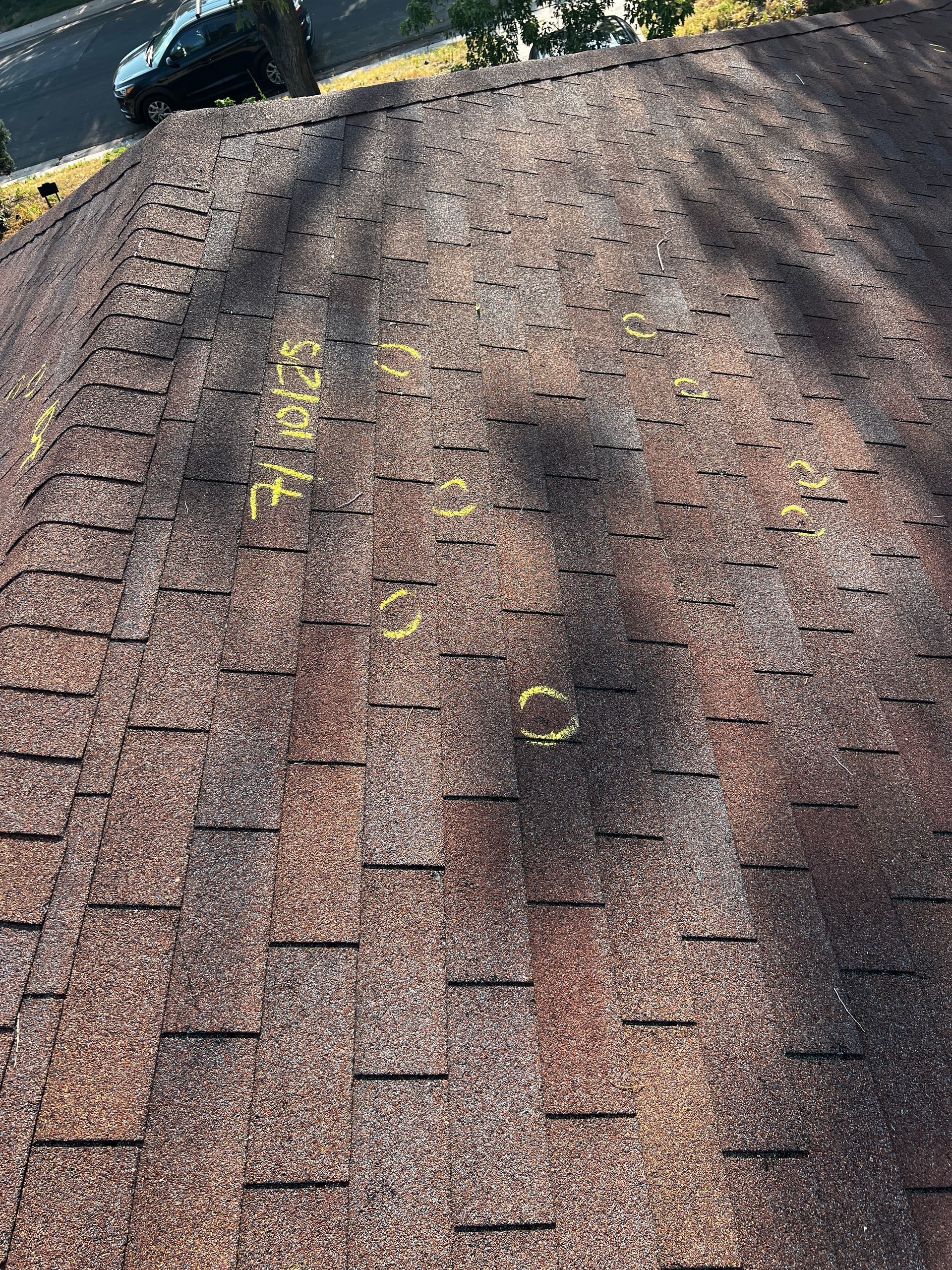
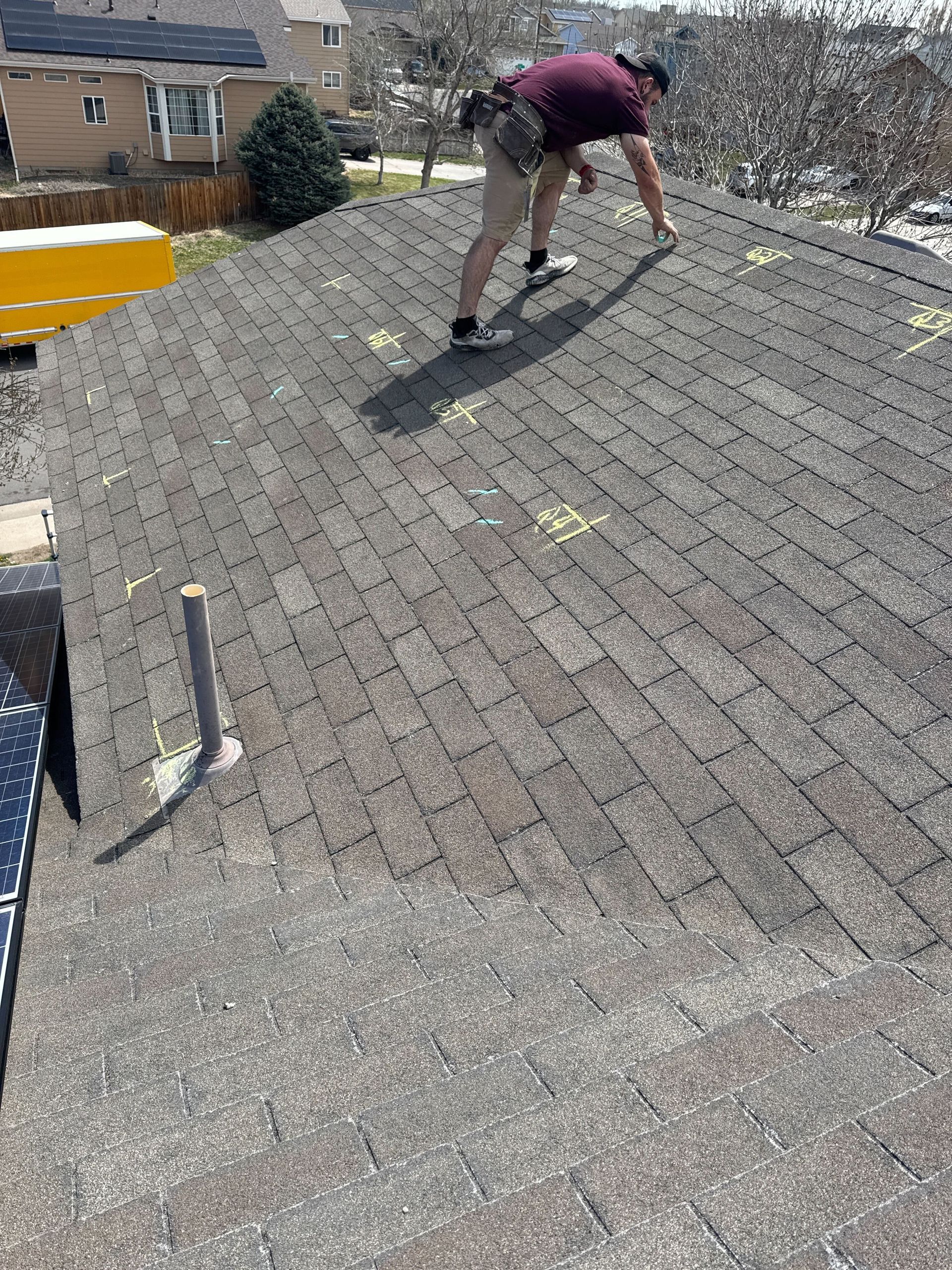
Shingle bruising and mat fracture. When hail strikes an asphalt shingle with sufficient force, it fractures the fiberglass mat beneath the surface — creating a bruise that is rarely visible without close examination. A bruised shingle has lost structural integrity at the impact point, which accelerates granule loss, moisture absorption, and eventual cracking. This is the damage that adjusters quantify using test squares — the 10×10-foot sections that form the basis of insurance damage documentation. Impact count per test square, combined with hail size estimation from soft metal denting, establishes the functional damage finding that supports a replacement claim.
Granule displacement. Asphalt shingles are protected by a layer of granules embedded in the surface. Hail impact knocks granules loose, exposing the underlying asphalt to UV radiation and moisture. Accelerated granule loss is one of the primary indicators inspectors document — and one of the leading causes of premature roof failure's high-altitude UV environment, where exposed asphalt degrades faster than at lower elevations.
Soft metal damage. Vents, flashing, pipe boots, ridge caps, and drip edge are made from aluminum, galvanized steel, or lead — all softer than shingle materials and more immediately dented by hail impact. Soft metal denting is used as a calibration reference during inspections because it provides clearer visual evidence of impact size and pattern than shingle surfaces alone. An adjuster who disputes shingle bruising findings typically cannot dispute consistent soft metal denting at the same impact diameter.
Cracked or fractured shingles. Larger hail can crack shingles through the full thickness, creating immediate water intrusion pathways. Cracked shingles at flashings, pipe boots, and roof valleys are particularly high risk because these are already the most water-vulnerable points in the roofing system.
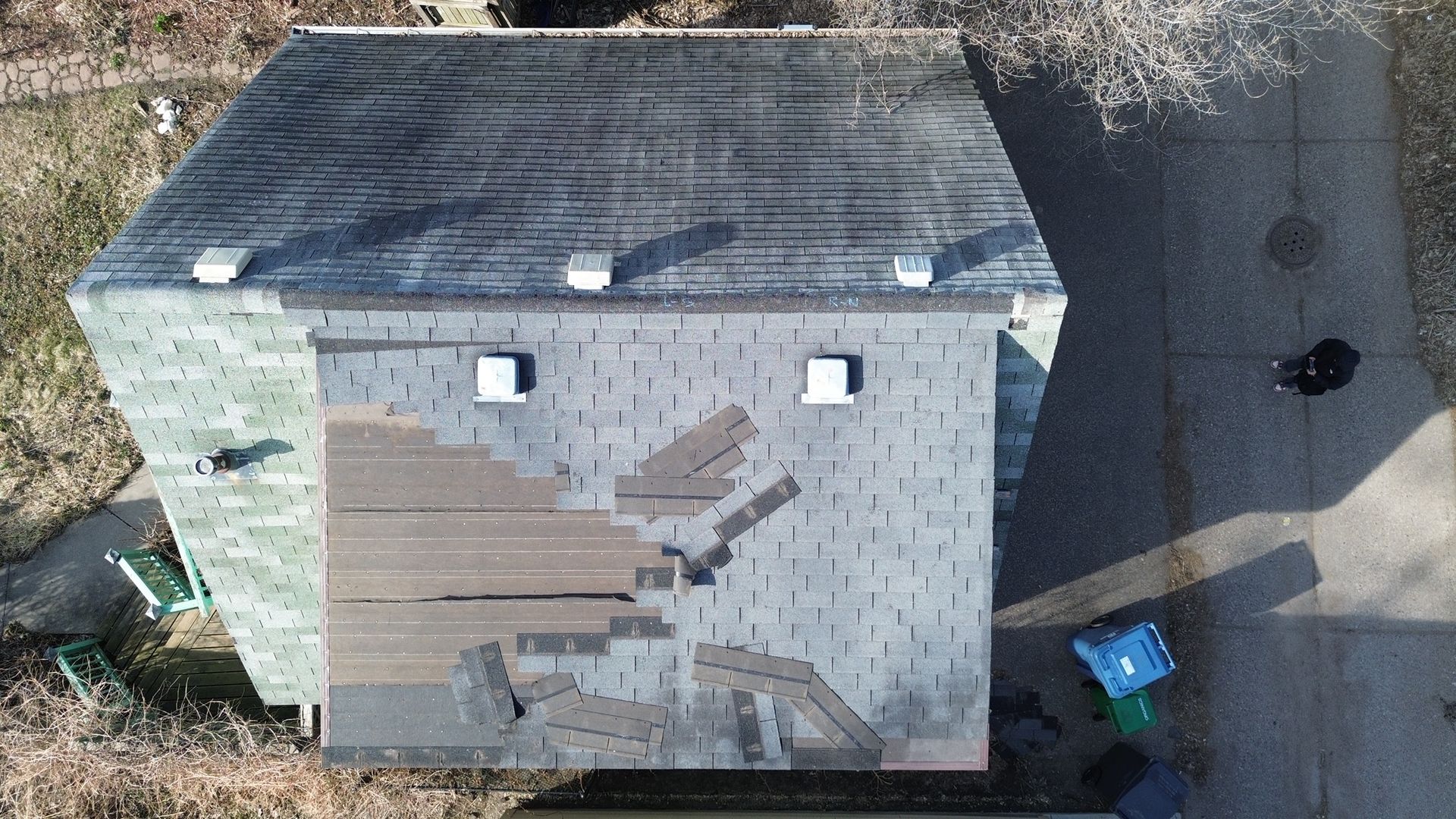
Underlayment exposure. In severe hail events, shingle damage can be extensive enough to expose the underlayment layer beneath. Any area where underlayment is visible represents an active water intrusion risk requiring prompt attention.
Learn more about roof repair → | Learn more about roof replacement →
Hail Damage to Siding
Siding is frequently overlooked after a hail event because homeowners focus on the roof — but siding takes direct lateral impact from wind-driven hail and is commonly damaged in the same storms that affect roofing.
Vinyl siding. Hail impact cracks, fractures, or punches through vinyl siding panels. Cracked vinyl allows moisture to penetrate behind the panel into the wall cavity, where it can cause mold growth, wood rot, and insulation degradation. Even small cracks in vinyl are functional damage — not cosmetic. A cracked vinyl panel that looks minor from the street is an active moisture entry point.
James Hardie and fiber cement siding. While more impact-resistant than vinyl, fiber cement siding can chip, crack, or have its surface coating compromised by large hail. Damaged fiber cement must be addressed to prevent moisture intrusion. Impact damage to James Hardie panels is a covered hail claim item — the higher material cost relative to vinyl is factored into the Xactimate replacement value.
Wood siding. Wood siding is particularly vulnerable to hail impact. Dents, splits, and surface damage allow moisture entry and accelerate rot. Wind-driven hail can strip paint or coating from wood siding, removing its primary moisture barrier and exposing the substrate to freeze-thaw cycling.
Coating and paint damage. On any siding material with a painted or coated surface, hail can remove or crack the coating without breaking the underlying material. Loss of surface protection accelerates weathering and moisture absorption in subsequent seasons — functional damage even without panel fracture.
Learn more about siding repair → | Learn more about siding replacement →
Hail Damage to Gutters and Drainage
Gutters and downspouts are exposed metal components that show hail impact clearly — which is why they are the standard calibration reference during hail damage inspections.
Denting and deformation. Hail dents aluminum gutters, deforming the channel cross-section and reducing drainage capacity. Significant denting causes gutters to hold standing water rather than drain properly — increasing overflow risk and accelerating corrosion at the dent points.
Gutter guard damage. Hail impact cracks or deforms gutter guard screens and panels, reducing their effectiveness and sometimes forcing debris directly into the gutter channel.
Downspout and fascia damage. Downspouts take direct impact on exposed faces and can be dented, disconnected, or displaced. The fascia board behind the gutter is frequently damaged when gutters are impacted — either directly by hail or by the gutter being pushed against it — allowing moisture intrusion at the roofline.
Learn more about gutter replacement → | Learn more about gutter guards →
Hail Damage to Windows and Doors
Cracked or shattered glass. Large hail or wind-driven debris can crack or shatter window glass. Even cracked glass that remains in place compromises insulation performance and is a safety concern.
Frame and screen damage. Window frames and screens take direct hail impact. Aluminum frames can dent and deform, compromising the seal between frame and glass. Screens are frequently destroyed in significant hail events — and torn screens are one of the most useful corroborating evidence items for establishing hail size across a property.
Seal failure. Impact or frame deformation can compromise the weatherproof seal around window units, leading to air and moisture infiltration that appears later as condensation between panes, drafts, or interior water staining.
Learn more about window replacement →
Why Hail Damage Is Often Missed Without a Professional Inspection
One of the most important things homeowners need to understand about hail damage is that the most significant damage is frequently not visible from the ground — and in many cases, not immediately obvious even during a close visual inspection without hands-on evaluation.
Subsurface bruising is invisible without contact. A shingle that has been bruised by hail may look completely normal from a distance. The damage is in the fiberglass mat beneath the surface, which can only be identified by pressing on the shingle and feeling the soft spot, or by close examination of the impact zone with the trained eye that recognizes the difference between a fresh impact and normal surface variation.
Granule loss blends in. Hail that displaces granules does not create an obvious void — partial displacement blends into normal surface variation. The full extent of granule loss often is not apparent until the roof is inspected systematically and compared against unaffected areas in the same slope.
Delayed water intrusion. A hail-damaged roof may not leak immediately after the storm. Water intrusion often develops weeks or months later when compromised areas are stressed by heavy rain, snowmelt, or freeze-thaw cycling. By the time a leak appears inside the home, the exterior damage has typically been present for a season or more — and the insurance claim filing window has been narrowing the entire time.
Multiple systems are affected simultaneously. Homeowners who notice obvious gutter denting or a few cracked shingles may not realize that the same storm also damaged siding panels, compromised window seals, and fractured pipe boot collars. A full exterior inspection evaluates all systems together rather than addressing one visible problem in isolation. The insurance claim that only addresses the roof on a full-building-envelope storm event leaves covered damage uncollected.
This is why a professional inspection after any significant hail event is worth scheduling even if you do not see obvious damage from the ground. The cost of an inspection is zero. The cost of missing functional damage and discovering it as a leak or rot problem a year later is significantly higher — and the insurance filing window may have closed.
Class 4 Impact-Resistant Shingles — The Shingle Math
Every hail damage replacement conversation involves a decision: standard architectural shingles or Class 4 impact-resistant shingles. Here is the honest math — not a sales pitch.
What Class 4 means: Class 4 is the highest UL 2218 impact resistance rating available for asphalt roofing shingles. The test drops a 2-inch steel ball from 20 feet onto the shingle surface — Class 4 shingles resist this impact without fiberglass mat fracture. Standard architectural shingles do not pass this test at 2 inches. In high-frequency hail environments, this rating difference is meaningful: Class 4 shingles routinely withstand hail events that produce functional damage on standard systems — the quarter-size to half-dollar-size events that occur multiple times per decade in Hail Alley.
Named Class 4 products available through Precision Exteriors:
- Owens Corning Duration Storm
- Owens Corning TruDefinition Duration Storm
- CertainTeed Landmark IR
The cost premium: Upgrading from standard architectural to Class 4 at the time of a full replacement costs approximately $1,000–$1,500 more on a typical your home. On an insurance-funded replacement, the incremental upgrade cost is the homeowner's out-of-pocket expense — the insurance settlement covers the standard replacement value, and the homeowner pays only the difference to upgrade.
The insurance discount: Most Colorado insurers offer 20–30% premium discounts for Class 4 installations. At an average your homeowner's insurance premium of $3,000–$4,000 per year, that discount is $600–$1,200 annually. Ask your insurer for the specific discount available on your policy before finalizing material selection — the answer informs the upgrade decision directly.
The payback calculation: At a $1,000–$1,500 upgrade premium and $600–$1,200 annual discount, the payback period is 1.5–2 years. Every year after payback, the discount is pure savings. Over the 20-year life of the shingle system, the net benefit to the homeowner at median discount values is $10,000–$15,000 — against a $1,000–$1,500 one-time cost.
The performance benefit beyond the math: A Class 4 system that survives a quarter-size to half-dollar-size hail event without functional damage eliminates the claim filing decision, the deductible exposure, and the premium surcharge risk that comes with filing. For homeowners who have experienced two or three hail events in a decade, the protection value is compounding.
The honest caveat: Class 4 shingles are not indestructible. Golf-ball-size and larger hail can produce functional damage on Class 4 systems — it takes a larger stone to do it, but the threshold is not infinite. A Class 4 system also does not protect siding, gutters, or windows — those systems require their own upgrade decisions.
Bottom line for homeowners: On an insurance-funded replacement, the Class 4 upgrade decision is almost always financially correct. The incremental cost is modest, the discount pays it back in under two years, and the long-term performance benefit in Hail Alley is substantial. Precision Exteriors presents both options on every replacement — the decision is yours, made with complete information.
Hail Damage Insurance Claims — From Inspection to Final Payment
This is the section most hail damage pages skip — because explaining the claim process in full reduces the homeowner's dependence on the contractor and creates an informed client who asks harder questions. We explain it anyway. An informed homeowner collects more of what they are owed.
Step 1 — Pre-Adjuster Inspection and Documentation
Call a licensed contractor before calling your insurer. Precision Exteriors performs a free close-range inspection of every exterior system — roofing, siding, gutters, and windows — before the adjuster arrives. Every damage point is photographed at close range, organized by system and slope, with impact counts documented per test square on the roofing scope.
This pre-adjuster record is the most important document in your claim. It establishes the damage condition before any weathering, additional events, or contractor activity can complicate damage attribution. An adjuster working without a pre-inspection contractor record is the only one defining what the damage is.
Step 2 — ACV vs. RCV — Know Your Policy Before the Adjuster Arrives
ACV — Actual Cash Value: The depreciated value of the damaged system at the time of loss. A 12-year-old roof on a 25-year shingle system has depreciated approximately 48%. An ACV payment covers roughly half of replacement cost. The homeowner pays the remainder out of pocket.
RCV — Replacement Cost Value: Full current cost to replace the damaged system with like-kind-and-quality materials. RCV policies pay in two installments: an initial ACV payment when the claim is approved, and a recoverable depreciation payment released after work is completed and documented.
Most Colorado homeowner policies are RCV. Check your declarations page before the adjuster arrives — it specifies ACV or RCV for each covered structure. If you are unsure, call your agent, not the claims line.
Step 3 — The Adjuster Meeting
Your contractor should be present when the adjuster inspects. Precision Exteriors attends every adjuster meeting on projects we are scoping. This ensures that:
- Nothing is overlooked during the adjuster's inspection
- Technical context for damage findings is provided on-site
- A shared documented record of what was observed exists
- Soft metal calibration references — gutter denting, vent denting — are specifically pointed out to establish hail size
Adjusters are professionals doing their job. Having your contractor present is not adversarial. It is standard practice and produces better claim outcomes for the homeowner.
Step 4 — Supplement Documentation
Initial adjuster scopes on hail claims routinely omit legitimate covered items. The most commonly missed line items on hail claims:
- Pipe boot replacement — hail impact accelerates rubber boot degradation; adjusters frequently omit pipe boots from hail scopes despite manufacturer guidance that they should be replaced on full system replacement
- Drip edge replacement — required at eave and rake by local building code on any full replacement; frequently omitted from initial scopes
- Ice and water shield — required at eave and in valleys per local building code when the existing system lacked it; frequently omitted
- Ventilation corrections — required when existing ventilation does not meet current code; frequently omitted
- Permit fees — required on every replacement; routinely omitted from initial scopes
- Overhead and profit — required on multi-trade projects coordinating roofing, siding, and gutters under one restoration contractor; frequently challenged by adjusters
- Gutter guards — frequently omitted when the existing system had gutter guards that were damaged in the same event
Each missing item is submitted as a supplement with supporting photos, measurements, and local building code citations. Most supplements are approved within 5–15 business days. The average hail damage claim increases 15–25% after full supplementing.
Step 5 — Recoverable Depreciation Collection
On RCV policies, the initial payment is ACV only. Recoverable depreciation — the difference between ACV and full replacement cost — is withheld until the work is completed and a completion package is submitted to the carrier.
On a full your roof replacement with a 12-year-old standard architectural system, recoverable depreciation is typically $2,000–$5,000. On a full exterior restoration including siding and gutters, it can reach $4,000–$10,000.
This payment does not arrive automatically. It requires a completion package — invoice, photos of completed work, and carrier-specific documentation — submitted to the carrier after project completion. Precision Exteriors prepares this package on every RCV claim. Homeowners who manage their own claims without contractor support frequently never collect this payment.
Our Hail Damage Inspection and Restoration Process
Step 1 — Free Inspection and Documentation We inspect every exterior system that takes hail damage: roofing components — shingles, flashings, pipe boots, ridge caps, vents, drip edge — gutters and downspouts, siding impact zones, window frames and screens, and fascia. Every finding documented with photos. Damage classified as cosmetic vs. functional, urgent vs. monitor. Written findings delivered before you call your insurer. Free, no obligation.
Step 2 — Clear Findings and Scope of Work Written explanation of what we found and what it means. If damage warrants repair or replacement, a detailed scope of work — every component, material specification, project timeline. If damage does not warrant action, we tell you that clearly and in writing. A contractor who tells you the roof is fine when it is fine earns more trust than one who always finds something.
Step 3 — Material Selection and Class 4 Decision For roofing we work with Owens Corning and CertainTeed product lines. Standard architectural and Class 4 impact-resistant options presented with full cost premium, insurance discount range, and payback calculation for your specific policy. Named Class 4 products: Duration Storm, TruDefinition Duration Storm, Landmark IR. For siding: vinyl, James Hardie fiber cement, and other options suited to exterior restoration scope.
Step 4 — Professional Restoration to Manufacturer Standards Installation to Owens Corning Preferred Contractor and CertainTeed Master Installer standards and local building code. A permit is pulled before work begins. Landscaping and property surfaces protected. Site cleanup completed same day.
Step 5 — Final Walkthrough, Warranty Documentation, and Depreciation Collection Final inspection confirming scope completed as agreed. 10-year workmanship warranty documentation provided. Completion package prepared and submitted for recoverable depreciation release on RCV policies. Manufacturer warranty documentation — Platinum Protection on qualifying Owens Corning systems, SureStart PLUS on qualifying CertainTeed systems — provided at project completion.
Hail Damage — Frequently Asked Questions
Can small hail cause real roof damage?
Yes. Hail as small as three-quarters of an inch can cause functional damage to asphalt shingles, particularly on roofs that have already experienced previous hail events or UV degradation. The cumulative effect of multiple smaller hail events is one of the most common causes of premature roof failure on your area properties. Size alone does not determine damage — impact velocity, wind angle, stone density, and the existing condition of the roofing material all factor in.
How long after a hail storm should I schedule an inspection?
As soon as it is practical — ideally within the first week after the event. Hail damage claims are subject to time limits under most Colorado homeowner's insurance policies — typically one to two years from the date of loss, though policy terms vary. Scheduling promptly ensures damage is documented while the storm event is unambiguous. Waiting also risks secondary damage developing from compromised areas before they are addressed — and narrows the filing window.
Does hail damage always require full roof replacement?
No. The right answer depends on the extent and distribution of damage, the age and condition of the roof, and the specific systems affected. Isolated damage — a few cracked shingles, a failed pipe boot, damaged flashing — may be addressed with targeted repairs. Widespread granule loss, fiberglass mat fracture across multiple slopes, or damage to a roof already near end of service life typically makes replacement the more practical long-term solution. We explain which path makes sense after the inspection, in writing, before any commitment is made.
What is a Class 4 impact-resistant shingle and is it worth it?
Class 4 is the highest UL 2218 impact resistance rating for asphalt shingles. The upgrade premium over standard shingles is $1,000–$1,500 on a typical replacement. Most Colorado insurers offer 20–30% premium discounts for Class 4 installations — $600–$1,200 per year at typical premium levels. The discount pays for the upgrade in 1.5–2 years. Named products: Owens Corning Duration Storm, TruDefinition Duration Storm, CertainTeed Landmark IR. For most homeowners on an insurance-funded replacement, the upgrade is financially correct.
Will you find damage if there isn't any?
No. Our inspection findings reflect what is actually there. If we inspect a roof and exterior after a hail event and do not find functional damage, we tell you that clearly and in writing. Our job is to give you accurate information — not to manufacture urgency or recommend work that is not needed. A contractor whose business depends on recommending replacement on every inspection loses the trust that produces 3,000+ completed projects over a decade.
What is the difference between ACV and RCV on a hail damage claim?
ACV pays the depreciated value of the damaged system — typically 40–60% of replacement cost on a 10–15 year old system. RCV pays full replacement cost in two installments: an initial ACV payment and a recoverable depreciation payment released after work is completed and documented. Most Colorado homeowner policies are RCV. Check your declarations page before the adjuster arrives.
What is recoverable depreciation and how do I collect it?
Recoverable depreciation is the difference between the initial ACV payment and full replacement cost on an RCV policy. On a full your roof replacement it is typically $2,000–$5,000. It requires a completion package submitted to the carrier after work is finished. Precision Exteriors prepares this package on every RCV claim. Homeowners who manage claims without contractor support frequently never collect it.
Does hail damage affect siding and gutters or just the roof?
Hail affects all exposed exterior systems simultaneously. In a significant storm event — quarter-size and above — roofing, siding, gutters, downspouts, window frames, screens, vents, and other exterior components all sustain damage. A claim that addresses only the roof on a full-building-envelope event leaves covered damage uncollected. We inspect the full exterior on every hail damage call.
What is the 10-year workmanship warranty?
All restoration work completed by Precision Exteriors is backed by a 10-year workmanship warranty covering installation defects and failures attributable to our work. This is separate from and in addition to manufacturer material warranties — Platinum Protection on qualifying Owens Corning systems, SureStart PLUS on qualifying CertainTeed systems.
How is hail damage different from normal wear and aging?
Hail damage is characterized by impact patterns — bruising, denting, and granule displacement that correspond to the size and distribution of hailstones across the roof surface, confirmed by consistent soft metal denting at the same impact diameter. Normal aging produces gradual, uniform deterioration. An experienced inspector distinguishes between the two and explains the specific findings and their basis in writing.
How do I avoid storm chasers after a hail event?
Verify any contractor's Colorado license at dora.colorado.gov before signing anything — takes two minutes. Check Google and BBB for local Denver-specific reviews, not generic testimonials. Ask how many projects the contractor has completed in your area in the last two years. Do not sign any document with Assignment of Benefits language, deductible waiver offers, or waived right of rescission. Precision Exteriors is Colorado License #0248041 — active and verifiable.
If your your home has been through a hail event — or if you are not sure whether previous storms have left damage — a free inspection is the right first step. We evaluate every exterior system, document what we find, and give you an honest picture of condition, claim potential, and material options before any commitment is made.
3,000+ completed projects. Owens Corning Preferred Contractor. CertainTeed Master Installer. Colorado License #0248041. BBB A+. 10-year workmanship warranty.
Free inspections. No obligation. 24-hour emergency response.
Schedule a Free Hail Damage Inspection → | Call (720) 408-1840 | View Service Areas →