
Roofing materials for Denver homes: Class 4 shingles, metal, and tile
In Denver's Hail Alley environment, the roofing material you choose is the single biggest variable you control. We install Owens Corning Duration Storm, CertainTeed Landmark ClimateFlex IR, standing-seam metal, and tile, then match the choice to your wind zone, your budget, and your insurance claim.
Book your free inspection
Pick a time and we send a written report with photos and a material recommendation within 24 hours.
Which roofing material is best for a Denver home?
Direct answer: For most Denver homes, Class 4 impact-resistant asphalt shingles, specifically Owens Corning Duration Storm, Duration Flex, or CertainTeed Landmark ClimateFlex IR, are the best balance of hail resistance, high-altitude UV stability, wind performance, and total cost of ownership. Standing-seam metal is the stronger long-horizon choice when you plan extended ownership, and tile suits homes whose structure and budget support the weight.
Roofing material selection in Denver is more consequential than it is in most US markets. The combination of Front Range hail frequency, high-altitude UV degradation that shortens asphalt service life beyond manufacturer predictions, three city-defined wind speed zones with material compliance requirements, and insurance premium structures that reward impact-resistant installations creates a material decision environment where the wrong choice costs Denver homeowners significantly more over time than the right one. This guide explains what each roofing material actually does in Denver's climate, what the Class 4 impact rating means and why it matters here specifically, which Owens Corning and CertainTeed product lines we install and recommend, and how material selection connects to your insurance claim outcomes. It is part of our wider Denver roofing services and links from the Denver roofing contractor hub.
Class 4 impact-resistant shingle
The highest UL 2218 impact rating, engineered to resist hail bruising and mat fracture at the stone sizes Denver sees most.
Why Denver: the appropriate baseline for Hail Alley, and qualifies for a statutory insurance premium discount.Standard architectural shingle
Affordable and fast to install, the right spec when budget or an insurance scope is set at standard architectural.
Why Denver: best entry value, with a modest upgrade path to Class 4 at replacement time.Standing-seam and metal
Concealed-fastener panels and metal systems that resist impact, shed snow, and last decades with low maintenance.
Why Denver: 40 to 70 year service life, superb snow shedding, and UV stability at mile-high elevation.Tile and flat roofing
Concrete or clay tile for maximum lifespan, plus membrane systems for low-slope and flat sections.
Why Denver: long-term durability where the roof structure supports the weight of tile.Why material choice matters more in Denver than most markets
Direct answer: Three Denver-specific factors shape every material recommendation we make: Front Range hail frequency, high-altitude UV degradation, and Denver's three city-defined wind zones. Each one changes which material actually performs to its rated service life here.
Front Range hail frequency. Denver sits in Hail Alley, the most hail-active corridor in North America, with multiple insurance-qualifying events per year and most homes facing two to four significant hail events per decade. The May 2024 Denver hailstorm produced $1.9 billion in metro-wide insured losses; the May 2017 event produced $2.3 billion. A standard architectural shingle sustains functional damage, fiberglass mat fracture, from hailstones at and above 1 inch. A Class 4 shingle sustains measurably less damage at those same stone sizes.
High-altitude UV degradation. At 5,280 feet, Denver's atmosphere provides roughly 25% less UV filtration than at sea level. A standard 30-year architectural shingle in Denver realistically performs 20 to 25 years, and a 20-year three-tab performs 15 to 18 years. Every recommendation we make accounts for that accelerated timeline.
Denver's three wind zones. Denver classifies properties into Zone 1 at 115 mph, Zone 2 at 125 mph, and Zone 3 at 140 mph. A shingle rated to 115 mph installed on a Zone 3 property does not meet code and will fail a city inspection, so we verify wind zone classification before finalizing any specification.
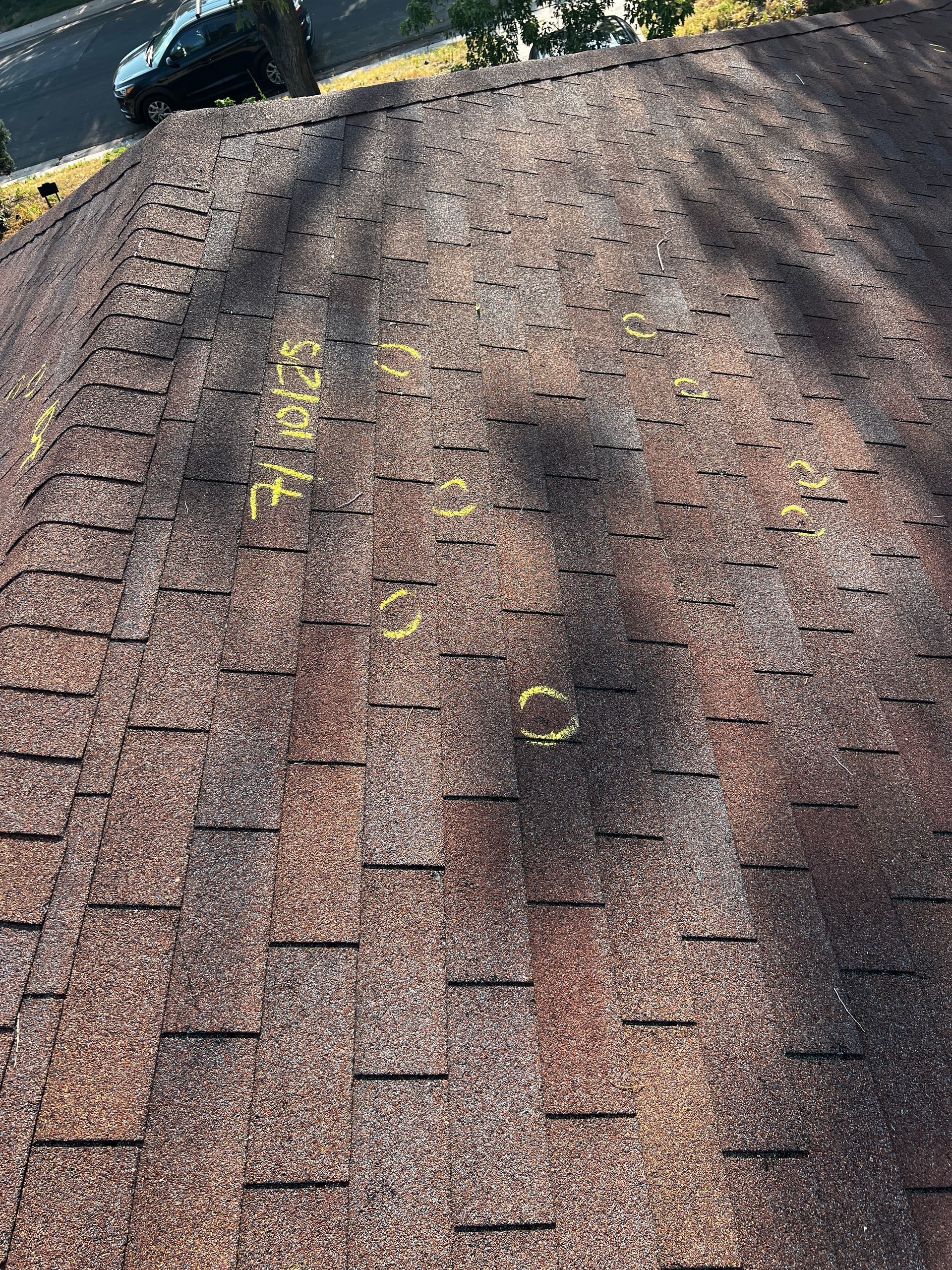 Hail mat fracture, Denver metro
Numbers behind the Denver material decision
Denver's storm frequency, altitude, and insurance law all push the same direction: impact resistance is a baseline here, not an upgrade.
Class 4 impact-resistant shingles, explained for Denver
Direct answer: Class 4 is the highest impact resistance rating for asphalt shingles under the UL 2218 standard. The test drops a 2-inch steel ball from 20 feet onto the same point twice, and the shingle must show no cracking, splitting, or backing fracture. For Denver's hail profile, where 1-inch hail is routine and 1.75-inch hail occurs in major events, Class 4 is the appropriate performance threshold, not an upgrade.
Class 1 through Class 3 ratings use progressively smaller steel balls, 1.25, 1.5, and 1.75 inches respectively. The Class 4 test approximates the impact energy of large hailstones at terminal velocity. The compound benefit in Denver is the reduction in intermediate replacement cycles: a standard shingle that sustains functional damage from a significant hail event produces a replacement claim, a new deductible, a new depreciation clock, and household disruption. A Class 4 shingle that survives the same event does not. Over a 20-year period in Hail Alley, that avoided replacement cycle is often the single most significant financial benefit of the upgrade.
| UL 2218 class | Steel ball size | Denver fit |
|---|---|---|
| Class 1 | 1.25 in | Below Denver's routine hail energy |
| Class 2 | 1.5 in | Below Denver's routine hail energy |
| Class 3 | 1.75 in | Marginal for Hail Alley conditions |
| Class 4 Recommended | 2 in, dropped twice | The appropriate Denver baseline |
Owens Corning and CertainTeed product lines for Denver
Direct answer: As an Owens Corning Preferred Contractor and a CertainTeed Shingle Master Installer, we install Class 4 lines including Owens Corning Duration Storm and Duration Flex, plus CertainTeed Landmark ClimateFlex IR and Northgate ClimateFlex IR. These credentials let us register the extended Platinum Protection and SureStart Plus warranties that most contractors cannot offer.
TruDefinition Duration Storm
Our most frequently recommended Class 4 shingle for Denver replacements, balancing impact resistance, wind performance, and color depth.
- WeatherGuard polymer backing keeps flexibility through freeze-thaw cycles
- SureNail triple-nailing zone carries a 130 mph wind warranty for Zone 1 and Zone 2
- TruDefinition colors: Estate Gray, Teak, Brownwood, Desert Tan, Onyx Black
- Platinum Protection warranty under Preferred Contractor installation
TruDefinition Duration Flex
SBS rubber-modified asphalt that increases flexibility and impact resistance, especially well-suited to Denver's aggressive cold-weather cycling.
- SBS modification holds performance below 32 degrees better than standard backing
- Same Class 4 UL 2218 rating as the Duration Storm
- Strong choice for homes in Denver's higher, colder microclimates
- Qualifies for the Colorado Class 4 premium discount
Landmark ClimateFlex IR
CertainTeed's Class 4 architectural shingle, a direct competitor to the Duration Storm, engineered for extreme temperature swings.
- ClimateFlex polymer holds impact performance from 90-plus highs to sub-zero lows
- Optional 130 mph wind warranty upgrade for Zone 1 and Zone 2
- Lifetime limited material warranty with SureStart Plus coverage
- Color continuity with the standard Landmark series
Northgate ClimateFlex IR
CertainTeed's premium Class 4 product, a heavier shingle with a more pronounced dimensional look and extra impact margin.
- Heavier base mat provides margin above the UL 2218 Class 4 threshold
- Same ClimateFlex polymer modification as the Landmark IR
- Available with the optional 130 mph wind warranty
- Best for homeowners who want a bolder dimensional appearance
Standard architectural option. The standard Owens Corning Duration and CertainTeed Landmark series are the right specification when budget constraints preclude the Class 4 upgrade, or when an insurance replacement scope is written at standard architectural. They share the same nailing and color platforms as their Class 4 siblings but do not qualify for Colorado's statutory Class 4 discount. For homeowners replacing under a claim at standard scope, the cost to upgrade to a Storm or ClimateFlex IR at replacement time is modest, and worth discussing with your carrier before finalizing.
Metal roofing in Denver: performance, cost, and insurance
Direct answer: Metal roofing is gaining share in Denver because it aligns with the city's exact climate challenges. Standing-seam, stone-coated steel, and metal shingle systems resist impact, carry 40 to 70 year service lives, stay UV-stable, and shed snow. Most carry Class 4 UL 2218 ratings and qualify for Colorado's premium discount.
Why metal performs well here. Metal does not fracture at impact points the way asphalt fiberglass mat does. It can dent from large hailstones, but denting does not compromise weather performance the way mat fracture does. There is no granule layer to displace, so the UV protection asphalt depends on, and that hail strips away, simply is not a failure mode for metal. Its smooth surface also sheds snow load more effectively, reducing ice dam formation at eave lines during Denver's late-winter melt.
Insurance and cost context. Class 4 metal systems qualify for the same statutory discount under C.R.S. section 10-4-110.8, and many Colorado carriers offer additional credits for metal. A small number price metal higher at the base rate because replacement cost exceeds asphalt, so verify your carrier's specific structure first. A standard residential metal installation in Denver typically runs $18,000 to $40,000 depending on system type and roof complexity, against $9,000 to $22,000 for asphalt replacement. For long ownership horizons, avoided replacement cycles and lower premiums frequently narrow that gap.
Get a metal roofing quote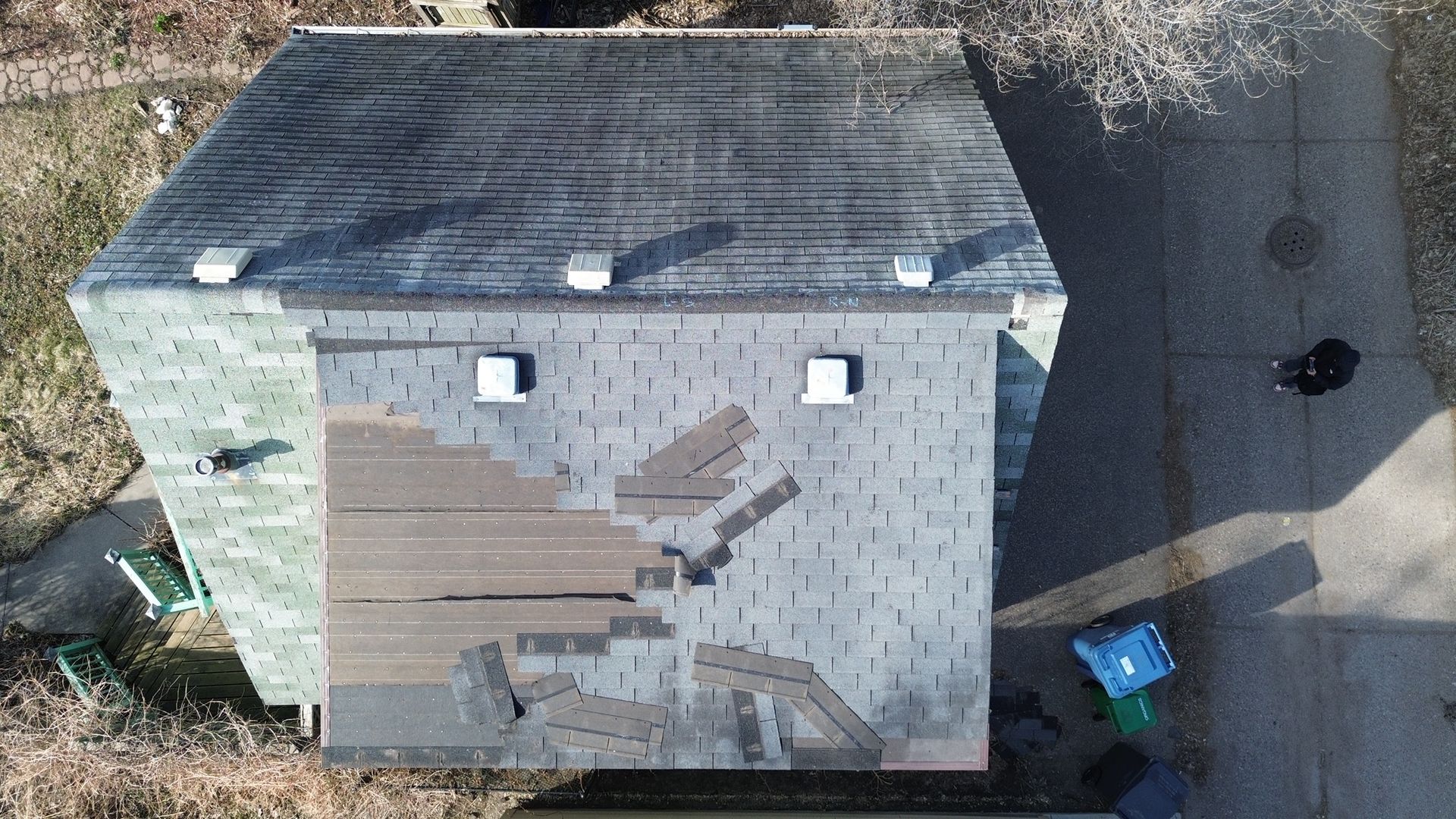 Wind damage assessment, Denver metro
What do Denver roofing materials cost?
Direct answer: In Denver, asphalt shingle replacement typically runs $9,000 to $22,000, and a standard residential metal installation runs $18,000 to $40,000 depending on system and complexity. Tile sits at the premium end where structure allows. Class 4 shingles cost modestly more upfront than standard architectural and tend to pay back through premium savings and avoided storm replacements.
Class 4 asphalt shingle
The Denver baseline. Owens Corning Duration Storm or CertainTeed Landmark ClimateFlex IR, qualifying for the statutory discount.
Standing-seam metal
Higher upfront, 40 to 70 year service life, excellent snow shedding, and strong total cost of ownership over a long horizon.
Tile and premium
Concrete or clay tile for maximum lifespan and curb appeal, suited to homes whose structure supports the added weight.
The complete Denver roofing system
Direct answer: Material selection is not only about the shingle. Every Denver replacement includes synthetic underlayment, ice and water shield, drip edge, ventilation, and new pipe boots and flashing. Several of these are Denver code requirements and warranty conditions, and they are the most common sources of post-installation leaks when omitted.
Synthetic underlayment
Better tear, UV, and moisture resistance than felt, and required for Platinum Protection and SureStart Plus warranty compliance.
Ice and water shield
Denver code requires a self-adhering membrane at eaves, valleys, and penetrations, the highest ice-dam and water-concentration risk areas.
Drip edge
Required at eaves and rakes by Denver code, often omitted from initial adjuster estimates and added back in our supplement documentation.
Balanced ventilation
Intake at soffits and exhaust at ridge protects decking and slows UV degradation from below, and is a manufacturer warranty condition.
Pipe boots and flashing
New pipe boots at every penetration and replaced flashing at every transition, the most common leak source when skipped.
Code and warranty compliance
We verify wind zone, code line items, and warranty conditions before finalizing the specification on your Denver replacement.
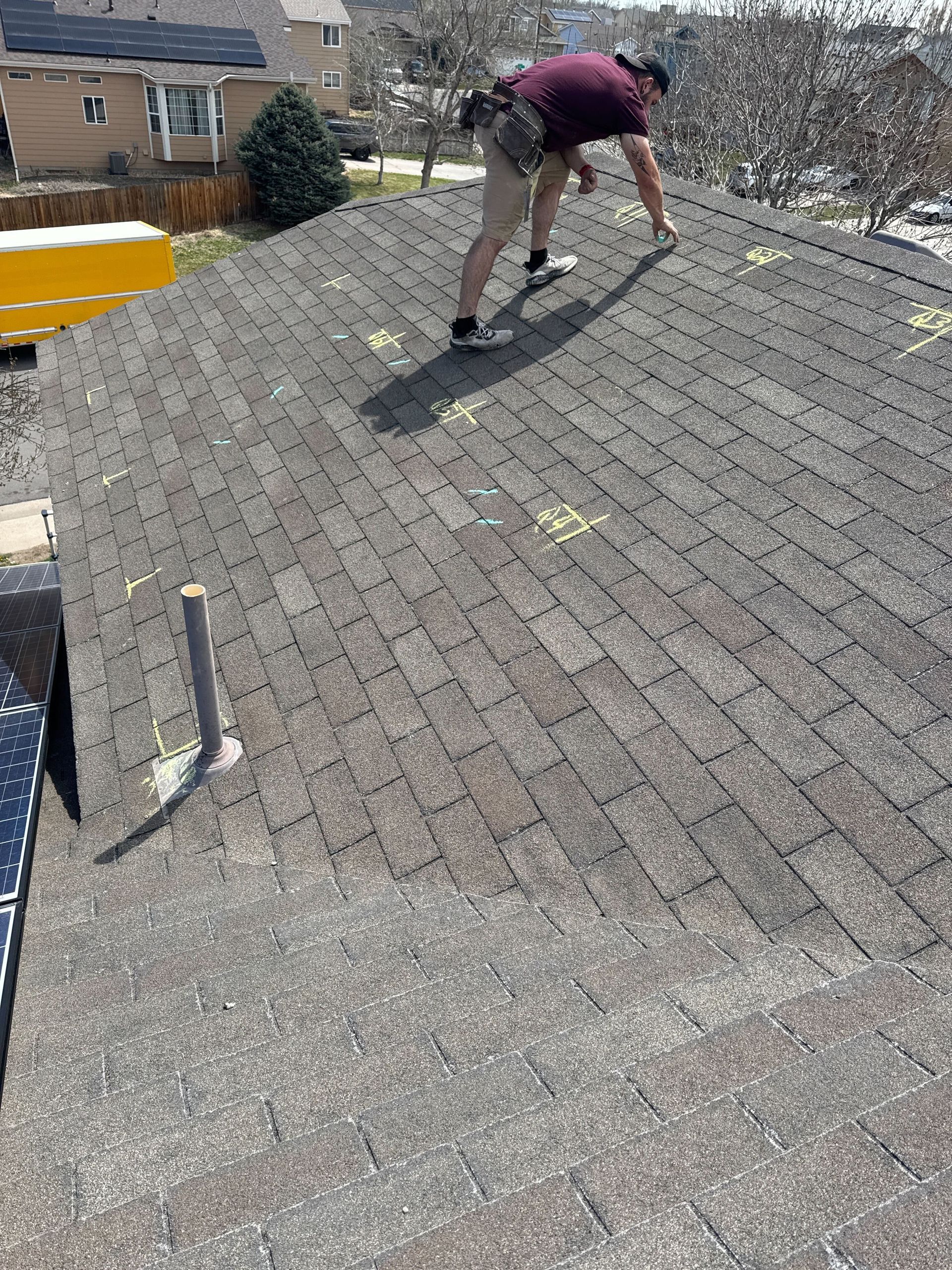 Material and damage documentation, Denver metro
How material choice connects to your insurance claim
Direct answer: Material selection interacts with your claim in two ways. First, the like-kind-and-quality standard entitles you to replacement at the damaged material's type and quality, not a downgrade. Second, the Class 4 upgrade is usually an out-of-pocket addition, though some Colorado carriers will fund it when you ask before scope is final.
- A home with standard architectural shingles is owed standard architectural replacement
- Upgrading to Class 4 is a modest add that often pays back through premium savings
- Ask your carrier directly whether they will fund the Class 4 upgrade in the settlement
- If a carrier ignores the statutory discount, the Colorado Division of Insurance can be contacted
- We document damage and meet your adjuster on site so nothing covered is left behind
For a full walkthrough of damage types and the claims process, see our Denver roofing services overview and our insurance and storm damage guidance.
Denver neighborhoods we serve for material consultation
Direct answer: We provide roofing material consultation and replacement throughout Denver, including Capitol Hill, Washington Park, Cherry Creek, Park Hill, Highlands, Sloan's Lake, Berkeley, Central Park, Montbello, and Green Valley Ranch. Recommendations vary by wind zone, hail track proximity, housing vintage, and HOA rules, with Zone 3 properties on Denver's western and southern edges requiring 140 mph wind-rated materials.
We also serve Aurora, Lakewood, Englewood, Wheat Ridge, Commerce City, Centennial, and surrounding Front Range communities. View our full service area.
The Precision Warranty
Protected in writing, for the long run
Every Precision Exteriors Restoration project is backed in writing, so your Denver roof and the material you chose stay protected long after our crew leaves.
10-Year Workmanship Warranty
The Precision Warranty covers the quality of our installation for a full decade, in writing.
Certified-Installer Manufacturer Warranty
As an Owens Corning Preferred Contractor and CertainTeed Shingle Master Installer, we register Platinum Protection and SureStart Plus material warranties most contractors cannot offer.
Licensed, Insured, Local Since 2016
Colorado License #0248041, BBB A+ accredited, with 3,000+ completed Front Range projects.
Rated 4.6 stars by Denver neighbors
Real, verified Google reviews from Denver-area homeowners. We are proud of an honest 4.6 stars rating built one roof at a time. Read our reviews.
"The Precision team was great and provided me with great customer service and results. Special thanks to Anthony for helping me through the insurance process in making sure the details were covered."
"Great quality work, friendly service. Fast and clean service."
"They showed up on time, they knew their stuff, they did the work, and they did it well."
"Could not give Precision Exteriors a higher recommendation. Professional, timely, and great to work with."
Denver roofing material questions, answered
What is the best roofing material for Denver's climate?
What is Class 4 and why does it matter in Denver specifically?
Does Colorado law require insurance discounts for Class 4 shingles?
What is the difference between Owens Corning Duration Storm and Duration Flex?
What is the difference between CertainTeed Landmark IR and Northgate IR?
Is metal roofing worth it in Denver?
What components matter beyond the shingle in a Denver roof replacement?
Will my insurance pay for a Class 4 upgrade after a Denver storm?
Get a free Denver material consultation
We inspect, we document, and we recommend the right material for your wind zone, your budget, and your insurance claim, with a written report and photos in 24 hours.