Storm, hail and leak roof repair in Denver: we find the real leak source , not the stain on your ceiling
Denver roofs fail at predictable weak points: pipe boots, flashing, wind-lifted shingles, and ice dams. We trace the failure to its source, define the smallest scope that genuinely fixes it, and document everything for your insurer. Free inspection, written report with photos in 24 hours.
Book your free inspection
Tell us where it leaks and we send a written report with photos within 24 hours.
Targeted roof repair across Denver, done at the source
Direct answer: Precision Exteriors Restoration is a licensed Denver roof repair contractor, Colorado License #0248041, handling active leaks, flashing failures, pipe boot replacement, wind damage, hail repair, and ice dam remediation. We trace each leak back to its actual entry point before we define a scope, so the repair holds instead of returning in six months.
Roof repair across the Denver metro: Arvada, Aurora, Brighton, Broomfield, Castle Rock, Centennial, Commerce City, Englewood, Federal Heights, Highlands Ranch, Lakewood, Littleton, Northglenn, Parker, Thornton, Westminster, Wheat Ridge.
Founded in Denver in 2016, we have completed more than 3,000 Front Range projects, with 200+ jobs in Denver, Aurora, and Montbello in 2024 and 100+ in Aurora and Denver in 2025. Denver-based and Denver-focused through every storm season since. As an Owens Corning Preferred Contractor, CertainTeed Shingle Master Installer, BBB A+ accredited, and an NRCA member, we back all repair work with a 10-year workmanship warranty, and every inspection and repair evaluation is free with no obligation.
Denver roofs do not fail at random. They fail at predictable weak points under predictable stress conditions. Knowing where those points are, what caused the failure, and what scope actually restores performance is the difference between a repair that holds and one that produces a return call. We start with a documented inspection, define the smallest scope that genuinely solves the problem, and complete the repair with proper transitions, not a spot seal that masks the entry point while the real failure continues. Need full system context first? See our Denver roofing services or jump to the Denver service area.
The Denver roof failures we fix most
Direct answer: The most common Denver repair scopes are pipe boot failures, step and chimney flashing, wind-lifted shingles, ridge cap displacement, valley flashing, ice dam intrusion, and active leak tracing. Each has its own scope, and none of them are solved by resealing the shingles on the slope below the stain.
Active leak repair
We trace the water pathway from the interior stain back to the real exterior entry point.
Pipe boot replacement
The single most common targeted repair in Denver, where UV cracks the rubber collar.
Chimney and step flashing
Resetting counter flashing into the mortar joint and reintegrating wall transitions.
Wind damage repair
Sealant bond failures, creased shingles, and displaced ridge caps after Chinook winds.
Hail damage repair
Functional impact repair at penetrations and isolated slopes, documented honestly.
Ice dam remediation
Eave-line intrusion fixes plus the ventilation correction that caused it.
Valley and skylight
Resetting lifted valley edges and replacing failed skylight perimeter flashing.
Emergency tarping, 24/7
Temporary protection for active exposure while permanent repair is scheduled.
The stain is almost never below the leak
Direct answer: A water stain on your ceiling is rarely located directly below the actual entry point. Water enters through a roof failure, travels along decking, rafters, or insulation, and surfaces at the lowest accessible point, often several feet or an entire roof section away. A proper Denver leak repair starts by identifying the real entry point, not by treating the visible spot.
Repairs that seal the visible spot without finding the source produce return calls within one to two rain events. This is the most common failure mode in Denver roof repair work, and the reason a real evaluation is not a 20-minute look with a caulk gun. We trace the water pathway from the interior stain back to the exterior failure zone before any scope is defined. The repair scope follows from the source, not from the symptom location.
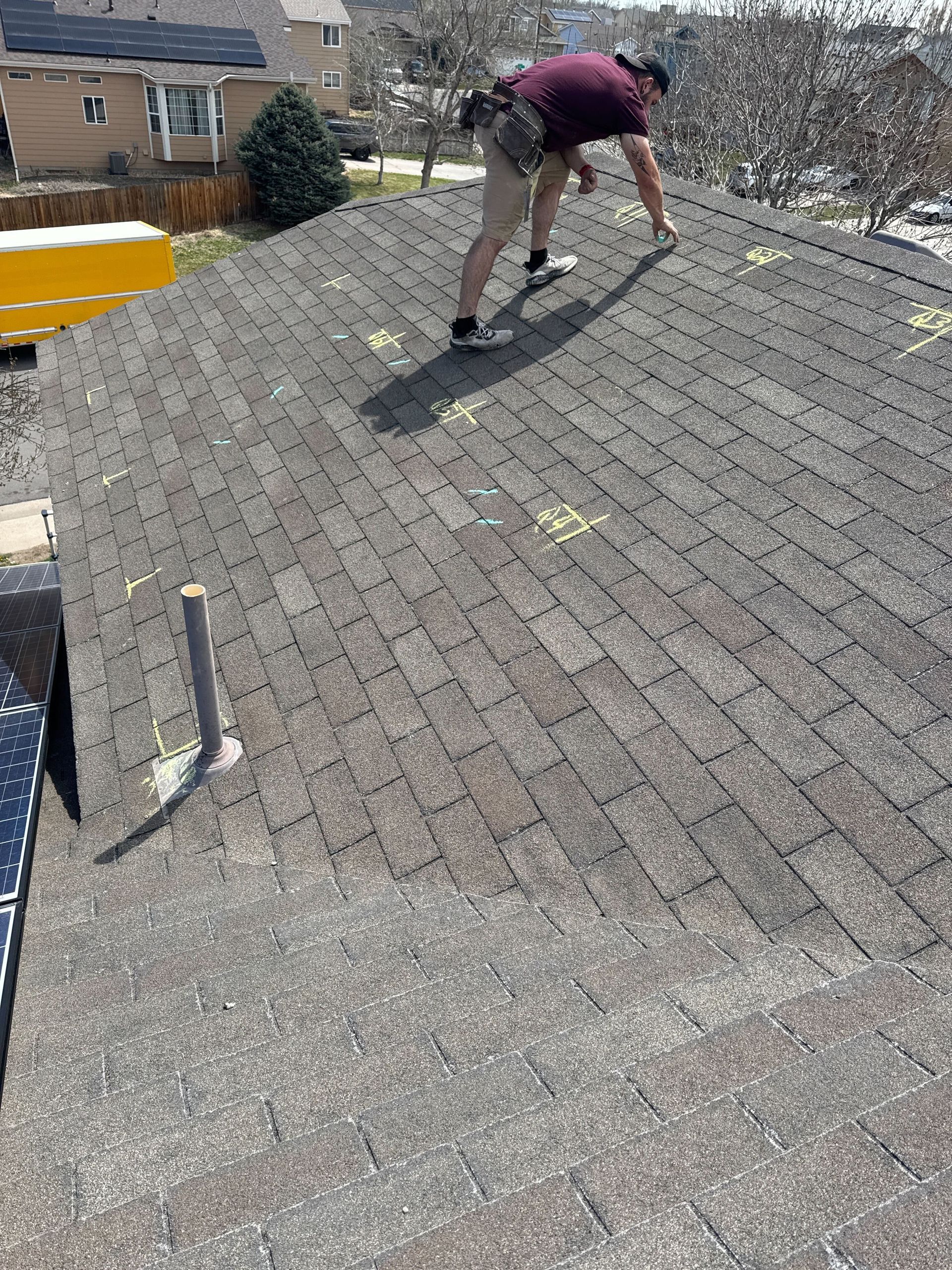 Leak source tracing, Denver metro
Common Denver roof repair problems, and why they happen
Direct answer: Denver's freeze-thaw cycling, high-altitude UV, and Front Range wind create specific failure patterns. Flashing failures are the most common leak source, wind drives sealant bond failure on shingles, and ice dams form at eave lines during winter thaw cycles.
Flashing failures
Flashings waterproof every transition: pipe penetrations, chimneys, skylights, dormers, and wall-to-roof connections. Pipe boots crack at the collar from UV and freeze-thaw, chimney counter flashing pulls from shifting mortar, and step flashing at dormers leaks into walls.
Why Denver: 40 degree daily swings accelerate flashing movement and collar degradation.Wind damage
Chinook downslope winds break the adhesive bond between shingle courses. A shingle with a failed seal looks intact from below but lifts and creases in wind, creating a hidden entry path. Ridge caps sit where velocity is highest and are the most wind-vulnerable component on any Denver roof.
Why Denver: sustained downslope winds expose underlayment that is not a weather surface.Hail damage at repair scale
Functional hail damage that affects performance, isolated flashing impacts or a cracked pipe boot collar, is repair scope. Cosmetic granule displacement without mat fracture is not. When mat fracture is distributed across all slopes, that is replacement scope, and we say so clearly.
Why Denver: Hail Alley impacts are common, but not all of them justify a repair.Ice dams and snowmelt
Heat loss warms the upper deck, meltwater runs to the cold eave overhang, refreezes, and backs up under the shingles. The fix has two scopes: the active entry point at the eave, which may need ice and water shield, and the underlying ventilation deficiency that caused it.
Why Denver: freeze-thaw winters make eave-line intrusion a seasonal repair pattern.What drives Denver repair calls
Denver sits in Hail Alley, where storm frequency and high-altitude conditions put roofs under more stress than almost anywhere in the country. These are the conditions behind most repair scopes we write.
See storm damage become a sound roof
Drag the slider to compare a wind and storm damaged Denver roof with the completed Precision Exteriors Restoration result. Every repair is documented this way for your records and your insurer.
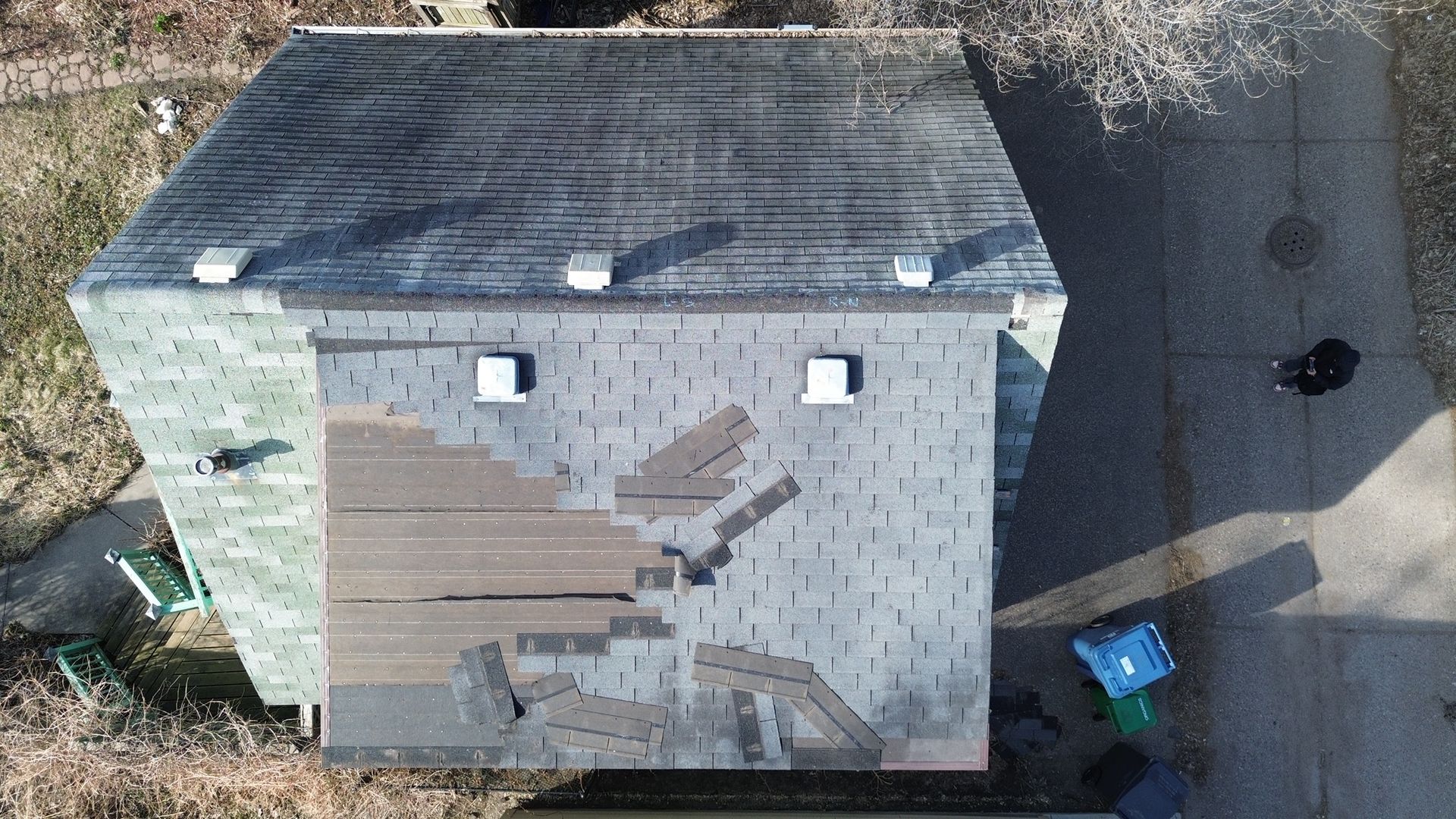
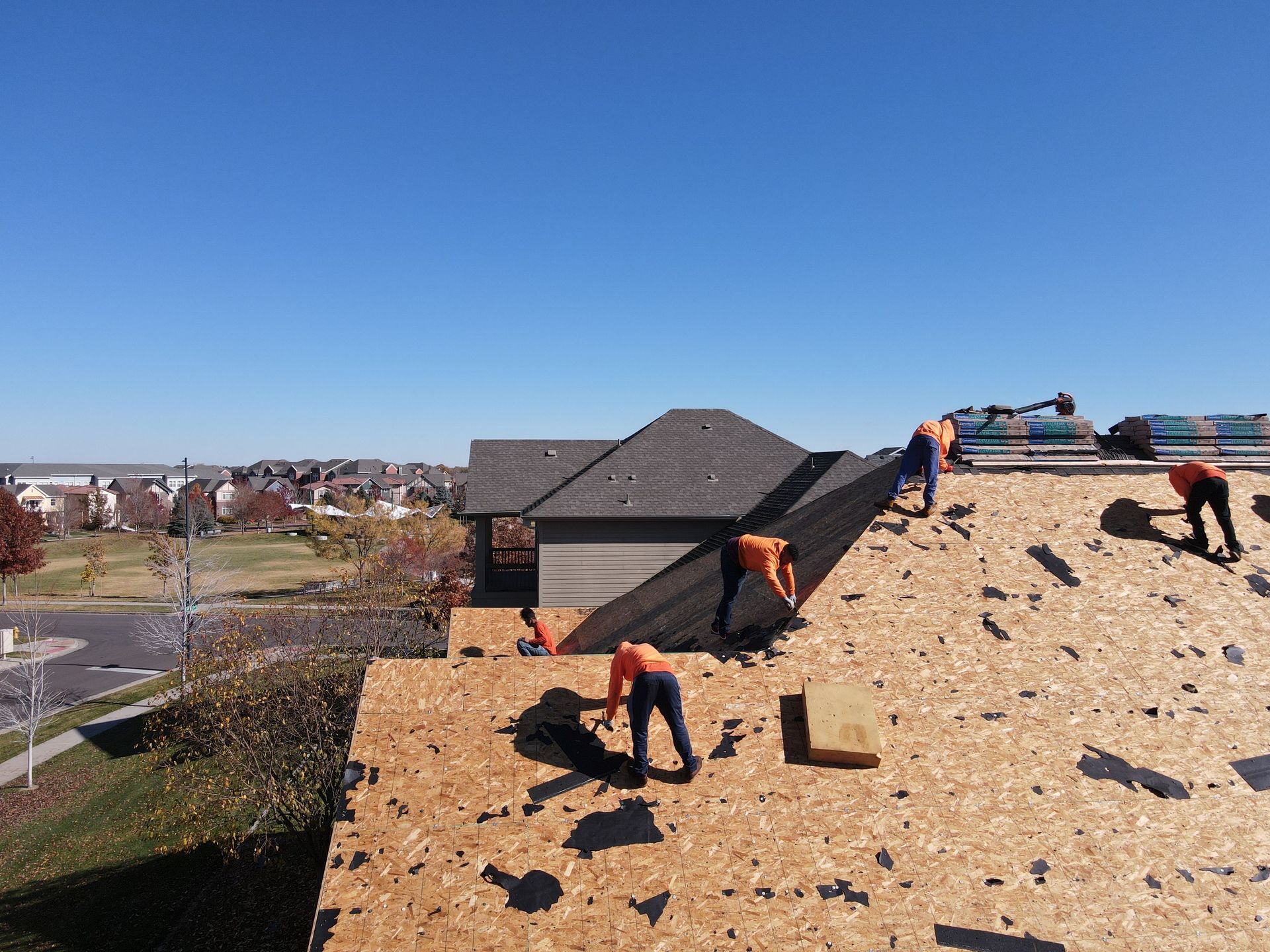
Drag to reveal the result. Real Colorado job, completed by Precision Exteriors Restoration.
What a Denver roof repair evaluation includes
Direct answer: A repair evaluation follows the same documented approach as a full inspection, because you cannot define an accurate scope without first understanding the failure source. We evaluate the surface, every flashing and penetration, and attic indicators, then give you a defined scope and a practical urgency assessment in writing.
Report the failure zone
Inspect surface and flashings
Trace the real source
Document with photos
Define the exact scope
Repair and verify
What you receive, and what we never do
No cost, no pressure, no same-day sales tactics. Here is exactly what an evaluation delivers.
- A clear explanation of the failure point and what caused it
- Photo documentation of the failure zone and contributing factors
- A defined repair scope, the specific work that fixes the verified failure
- A practical urgency assessment before the next weather event
- Insurance documentation in Xactimate format when the loss is covered
- An honest call if the issue is replacement scope, not repair scope
Roof repair vs. replacement in Denver
Direct answer: The repair vs. replacement question in Denver comes down to three factors: damage distribution, system age and condition, and whether repair restores genuine long-term performance or just delays the inevitable. We recommend repair when repair is the right answer, and replacement when it is not.
Repair is right when
- Damage is isolated: a specific penetration failure, lifted shingles on one slope, flashing failure at a defined transition.
- The surrounding system is sound, with materials that still seal correctly and meaningful service life left.
- The scope restores full performance without creating a patchwork of mismatched sections.
Replacement is right when
- Hail or wind damage is distributed across the full roof surface, so isolated repairs cannot restore the system. See our roofing overview.
- System age is 18 to 22+ years in Denver UV, where brittle materials no longer seal after repair.
- Repeat failures at the same locations signal progressive, systemic instability.
If the findings are genuinely ambiguous, we explain the specific factors at play and let you make the decision with complete information. Related pages: storm damage in Denver and emergency roofing in Denver.
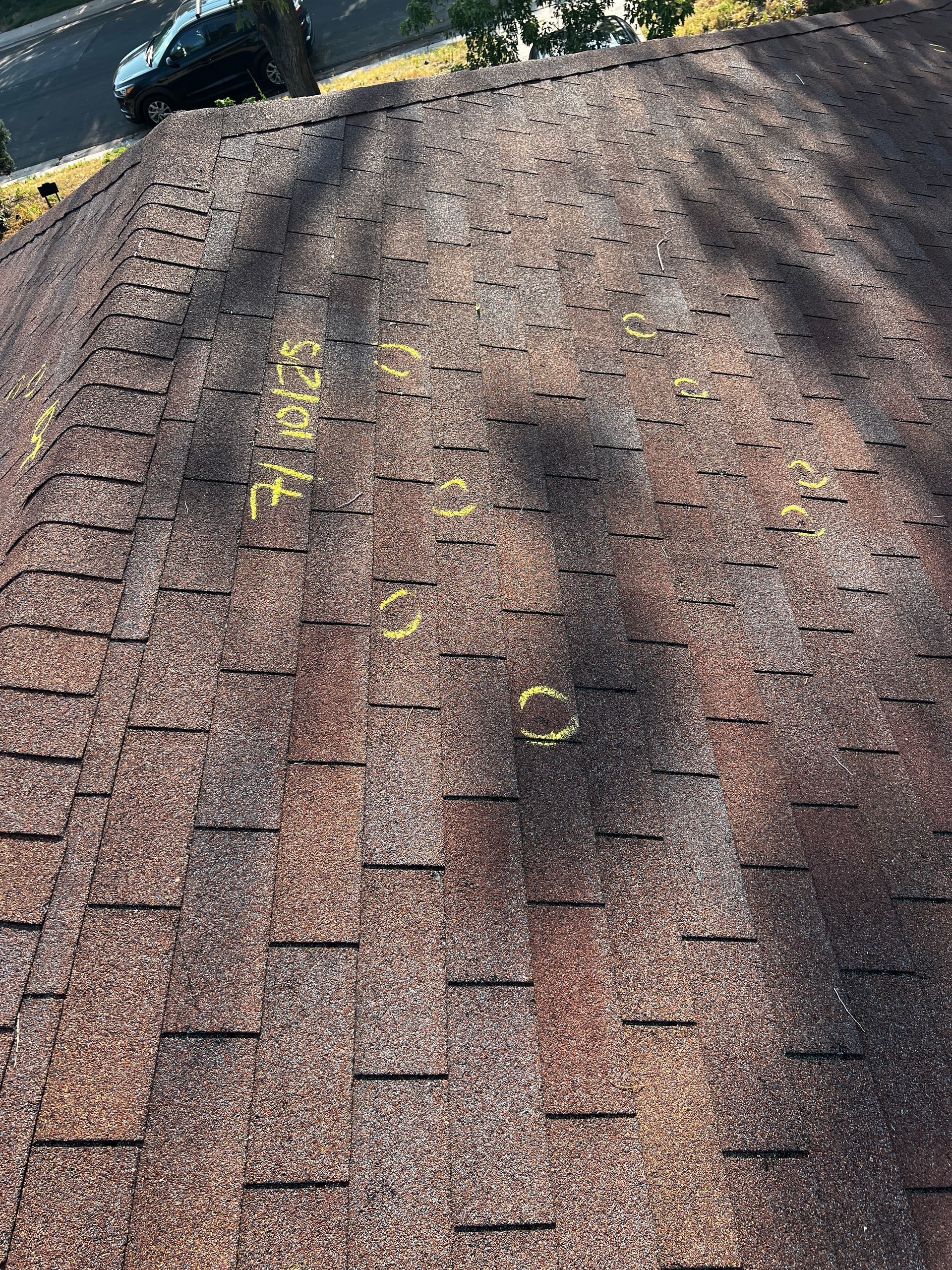 Hail impact documentation, Denver metro
A repair partner that fixes the cause
Direct answer: Since 2016, Precision Exteriors Restoration has completed more than 3,000 Front Range projects with certified crews, an A+ BBB rating, and a source-first repair method that distinguishes functional damage from cosmetic and replacement scope from repair scope.
- Denver based since 2016, with 3,000+ Front Range projects completed
- Owens Corning Preferred Contractor and CertainTeed Shingle Master Installer
- BBB A+, NRCA member, licensed and insured (License #0248041)
- 10-year workmanship warranty on all repair work
- We trace the source first, then repair, instead of masking the symptom
A repair you can trust to hold
A repair should solve the problem once. Between our source-first method, manufacturer-backed materials, and direct insurance documentation, every Denver repair is low risk from the first visit.
10-year workmanship warranty
Every repair is backed in writing for a full decade, so the transition we rebuild stays watertight long after our crew leaves.
We document your claim
We prepare insurance documentation in the same Xactimate format used for replacement claims, distinguishing storm loss from normal wear.
24-hour emergency response
If water is entering your home right now, we provide emergency tarping to stop active exposure before permanent repair.
Rated 4.6 stars by Denver neighbors
Real, verified Google reviews from Denver-area homeowners. We are proud of an honest 4.6 stars rating built one roof at a time. Read our reviews.
"The Precision team was great and provided me with great customer service and results. Special thanks to Anthony for helping me through the insurance process in making sure the details were covered."
"Great quality work, friendly service. Fast and clean service."
"They showed up on time, they knew their stuff, they did the work, and they did it well."
"Could not give Precision Exteriors a higher recommendation. Professional, timely, and great to work with."
Denver neighborhoods we serve for roof repair
Direct answer: Precision Exteriors Restoration provides roof repair evaluations throughout Denver, including Capitol Hill, Washington Park, Cherry Creek, Park Hill, Highlands, Sloan's Lake, Berkeley, Congress Park, Central Park, Montbello, and Green Valley Ranch, plus Aurora, Lakewood, Englewood, Wheat Ridge, and Commerce City.
Denver's weather exposure varies by elevation, roof slope, and wind direction, meaning one elevation of a home can show significant storm impact while the adjacent face looks undamaged. We account for directional exposure in every inspection. View our full Denver service area.
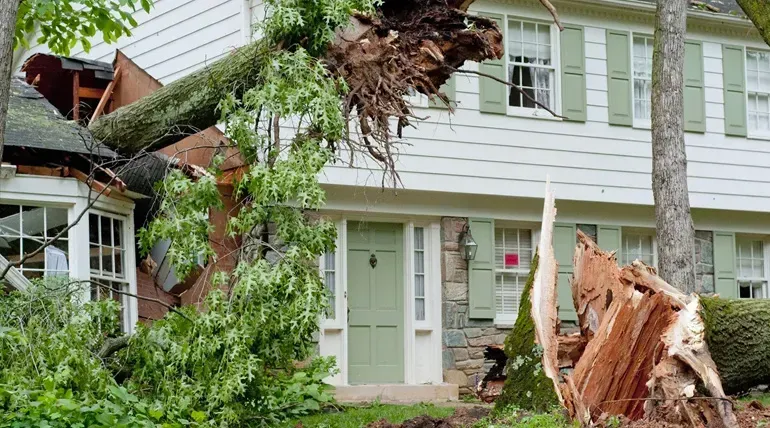 Storm response, Denver neighborhoods
The Precision Warranty
Protected in writing, for the long run
Every Precision Exteriors Restoration repair is backed in writing, so the Denver roof transition we rebuild stays protected long after our crew leaves.
10-Year Workmanship Warranty
The Precision Warranty covers the quality of our repair installation for a full decade, in writing, on all repair work.
Certified-Installer Manufacturer Warranty
As an Owens Corning Preferred Contractor and CertainTeed Shingle Master Installer, we register manufacturer-backed material warranties most contractors cannot offer.
Licensed, Insured, Local Since 2016
Colorado License #0248041, BBB A+ accredited, NRCA member, with 3,000+ completed Front Range projects.
Denver roof repair questions, answered
What are the most common roof leak sources in Denver?
Can a targeted repair prevent the need for full replacement?
How quickly should roof damage be repaired after a Denver storm?
How long does a typical Denver roof repair take?
Are roof repairs covered by homeowner's insurance in Denver?
What is the difference between roof repair and emergency roofing services?
How do I know if I need repair or full replacement?
Are your Denver roof repair contractors licensed and insured?
Book a free Denver roof repair evaluation
Get a written report with photos in 24 hours. We trace the real source, define the exact scope, and document your claim, so the repair holds and you do not get a return call.